Small Modular Reactors and the AI Data Center Power Crisis: A Second-Generation Analysis
The corporate announcements are signed. The engineering is real. The timeline is the problem.
At a Glance
The convergence of AI infrastructure demand and nuclear power supply has moved from theoretical alignment to signed agreements. Microsoft, Google, and Amazon have collectively committed to sourcing hundreds of megawatts of nuclear-origin electricity, with delivery windows targeting the early-to-mid 2030s. On paper, the size match between a next-generation Small Modular Reactor and a hyperscale AI data center is unusually elegant — both operating in the 50–300 MW range. In practice, the gap between an elegant fit and a functioning power plant is measured in regulatory years, fuel supply chains, and capital structures that the industry has not yet solved.
This article is a second-generation treatment. In our earlier analysis, we identified SMRs as a promising pathway out of the AI industry's structural power deficit. The deeper technical picture reveals a more complex timeline than the announced corporate deals suggest. We examine the design taxonomy that the term "SMR" obscures, the engineering tolerances that determine whether a reactor can actually serve a data center's variable load, and the geopolitical chokepoints that could derail the entire program before a single commercial unit comes online.
A note on sourcing: One patent citation flagged in our research — Microsoft patent application 20220068510 — was identified as unverified and has been excluded from the analysis pending independent confirmation. It is noted here for transparency rather than silently omitted.
The Narrative Continuity Problem
Before going further into the technical architecture, it is worth anchoring this analysis to what came before. The grid problem we documented in prior coverage — transmission constraints, aging infrastructure, the structural mismatch between centralized generation and distributed high-density demand — is not solved by Small Modular Reactors. It is deferred. The question is whether that deferral buys enough time for the nuclear timeline to actually deliver.
That distinction matters because the data centers being commissioned and powered up today will not wait for SMRs. They will draw from the grid, from natural gas peakers, and from large-scale renewables. SMRs are not a solution to the current power crisis; they are a potential solution to the next capacity expansion cycle — the one that begins in earnest around 2030. Understanding this timeline correctly is essential for evaluating the corporate commitments now being announced at scale.
The Design Taxonomy: What "SMR" Actually Means
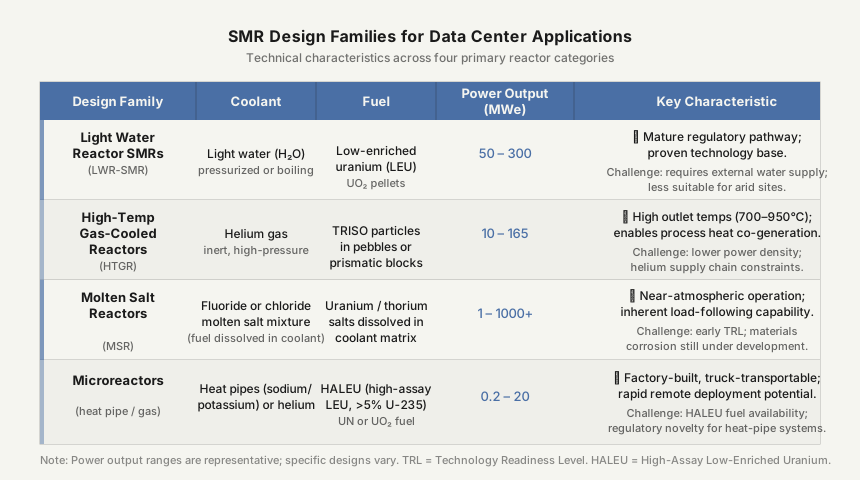
The term "Small Modular Reactor" is doing significant rhetorical work while concealing substantial technical heterogeneity. Four distinct design families are relevant to data center applications, and they differ not just in size and cost but in physics, fuel requirements, regulatory maturity, and the specific value they can offer a compute campus.
Light Water Reactor SMRs: The Near-Term Path
The closest analog to conventional nuclear power — pressurized or boiling water physics at reduced scale — offers the most understood regulatory pathway. The physics are proven; the question is whether the economics of smaller scale justify the construction.
NuScale Power's module holds the distinction of being the first SMR to receive a Standard Design Approval from the U.S. Nuclear Regulatory Commission, producing 77 MWe per module in configurations scalable to twelve units. That milestone is real. What is equally real is the cancellation of the Carbon Free Power Project in Idaho in 2023 — the canonical first deployment — when cost estimates reached $9.3 billion for a six-module plant. The NuScale SDA is a regulatory achievement; it is not a proof of commercial economics.
GE-Hitachi's BWRX-300 occupies a more pragmatically positioned slot in the near-term landscape. At 300 MWe, it sits at the upper boundary of what most definitions classify as "small," but its natural circulation design — eliminating active cooling pumps — reduces both capital cost and the category of active safety systems that can fail. Active licensing proceedings with Ontario Power Generation in Canada and preliminary engagement in the UK give it a more credible near-term deployment trajectory than most of its peers, with a realistic first-power window of 2029–2031 in Canada.
High-Temperature Gas-Cooled Reactors: The Co-Generation Case
HTGRs use helium coolant and TRISO fuel — ceramic-coated uranium microspheres that are physically incapable of melting under accident conditions. That safety characteristic is relevant not just for public acceptability but for potential siting flexibility near high-value infrastructure. More significantly for data center applications, HTGRs produce both electricity and high-grade process heat at temperatures up to 750°C and above, opening co-generation possibilities that pressurized water designs cannot offer.
X-Energy's Xe-100, an 80 MWe pebble-bed design, received $80 million in DOE Advanced Reactor Demonstration Program funding and has signed a deployment MOU with Dow Chemical for an industrial site — a meaningful signal that the behind-the-meter, co-located industrial model is being taken seriously by industrial energy consumers. Amazon has committed to an agreement with Energy Northwest and X-Energy to develop up to 960 MWe of Xe-100 capacity in Washington State. It is important to be precise about what that commitment represents: the Xe-100 carries a Technology Readiness Level of approximately 5–6, meaning the design is validated at sub-scale but has not been built and operated as a complete system. Amazon's agreement reflects confidence in X-Energy's trajectory, not near-term delivery certainty.
The only commercially operating HTGR in the world is China's HTR-PM in Shandong Province, which connected to the grid in December 2023. Two 250 MWt reactors drive a single 210 MWe steam turbine. This is not speculative — it is a functioning power plant. The geopolitical implications of that fact, however, are considerable and addressed in the global context section below.
Molten Salt Reactors: High Upside, Unresolved Materials Challenges
Molten Salt Reactors operate with liquid fuel dissolved in fluoride or chloride salts at near-atmospheric pressure, eliminating the high-pressure containment requirements of conventional light water designs. The theoretical advantages are significant — passive safety through freeze-plug drain mechanisms, the ability to use thorium or existing spent fuel, and the absence of fuel fabrication as a separate industrial process. The practical challenge is materials science: the corrosive behavior of molten salts on structural alloys at operating temperatures is not fully solved.
Terrestrial Energy's Integral MSR addresses the long-term corrosion challenge architecturally — by designing the primary salt circuit as a sealed, replaceable unit that is swapped out on a scheduled basis rather than repaired in-situ. The design has completed Phase 2 of Canada's Vendor Design Review process. Kairos Power's FHR takes a hybrid approach: TRISO solid fuel from the HTGR family, but with liquid fluoride salt coolant operating at lower pressure. The NRC issued Kairos a construction permit for a non-power demonstration reactor in Tennessee in 2023 — the first non-LWR construction permit issued by the NRC in decades, which is a notable regulatory milestone regardless of the design's distance from commercial deployment.
Microreactors: The Packaged Product Model
Sub-10 MWe designs are the least proximate to large hyperscale power requirements, but one entrant in the broader microreactor category warrants specific attention for its business model rather than its technical novelty. Last Energy's PWR-20 — a 20 MWe pressurized water reactor — is explicitly positioned as a "power plant as a product": pre-engineered, packaged, and delivered to a customer site. The company's published cost estimates fall in the range of $3,500–$5,000 per kilowatt-electric. It should be noted clearly that no independently verified cost analysis exists for this design, and these figures carry high uncertainty. They should be treated as company estimates, not benchmarks. The PWR-20 is also currently at TRL 5–6, consistent with a pre-demonstration stage.
The Technology Readiness Gap: An Honest Assessment
The following synthesis of verified readiness data establishes the realistic deployment picture. TRL values represent approximate assessments based on DOE framework definitions; cost estimates are drawn from DOE reports and industry analyses and carry meaningful uncertainty ranges.
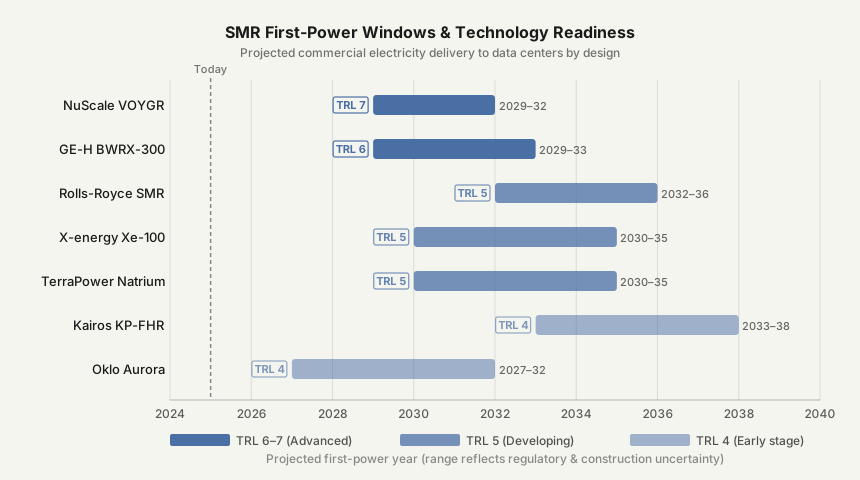
NuScale's NPM sits at TRL 8 — design approved, no unit built — with a realistic first-power window of 2030–2033 and per-MWe estimates ranging from $8,000 to $12,000. GE-Hitachi's BWRX-300 is at TRL 7–8 with a 2029–2031 window in Canada at $5,000–$8,000 per kWe. China's HTR-PM is at TRL 9 — operating — at an estimated $4,000–$6,000 per kWe, but accessible only to Chinese operators. X-Energy's Xe-100, at TRL 5–6, targets 2030–2035. Kairos and Terrestrial designs are at TRL 4–5 with deployment windows extending to 2032–2036 and no publicly verified independent cost analyses. Last Energy's PWR-20, at TRL 5–6, targets 2027–2029 with estimates that carry high uncertainty and no independent verification. Oklo's Aurora sits at TRL 4–5 with a 2027–2028 target; at approximately 1.5 MWe, it is too small to be directly relevant to hyperscale power requirements.
The composite picture: the realistic window for SMR-origin electrons flowing to an AI data center is 2028–2033, with the leading candidates being Last Energy's packaged model (contingent on claimed timelines and unverified economics holding), GE-Hitachi's BWRX-300 in Canada, and potentially early Xe-100 deployments if Amazon's Washington State project progresses on schedule. Notably, Microsoft's most proximate nuclear deal — the Constellation PPA for the Crane Clean Energy Center restart of Three Mile Island Unit 1, delivering 835 MWe under a 20-year agreement — avoided new reactor licensing entirely by restarting an existing licensed facility. That workaround is not available at scale.
The Load-Following Problem
Prior coverage correctly established the power demand issue. A less-examined engineering question is whether SMRs can actually serve a data center's variable consumption profile, as opposed to simply being co-located near one.
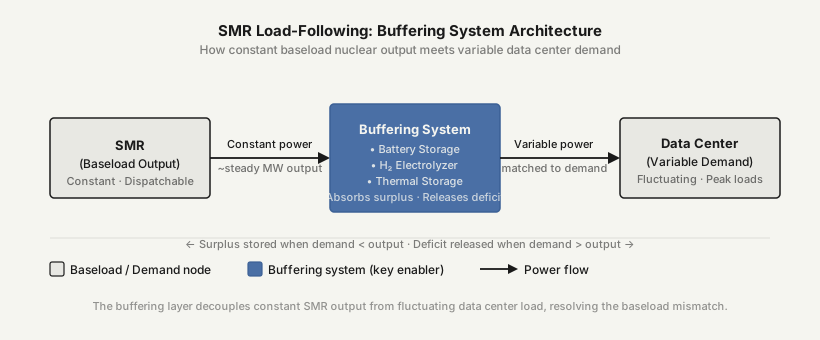
Data center power consumption is not flat. It fluctuates with workload scheduling, cooling loads that vary with ambient temperature and season, and the different power signatures of training versus inference workloads. Traditional nuclear plants are designed for baseload operation at constant thermal output, because changing power levels requires slow neutron flux adjustments that stress fuel rods through thermal cycling.
The answer is design-dependent. Light water SMRs — NuScale and the BWRX-300 — can perform load-following, but the NRC's safety evaluations for this operating mode note that rapid power changes in LWRs can induce xenon oscillation: a buildup of neutron-absorbing xenon-135 that creates reactivity instability in the core. This is manageable with sophisticated control systems, but it is an operational constraint, not a free parameter.
HTGR designs have significantly better load-following characteristics. The large thermal mass of the graphite moderator acts as a buffer against rapid thermal transients, and the pebble-bed geometry specifically provides a negative temperature coefficient of reactivity — as the core heats up, power naturally decreases. This inherent stability makes HTGRs more forgiving of the variable demand profile that data centers generate.
For LWR-type SMRs in particular, the practical solution will likely involve decoupling the reactor's electrical output from the data center's instantaneous consumption using battery buffer systems or hydrogen electrolysis as an absorber for excess generation. When the reactor produces more power than the data center requires at a given moment, the surplus charges batteries or runs an electrolyzer; when demand peaks, batteries discharge to supplement reactor output. Speculation: this buffering layer represents an additional capital cost that is not typically modeled in SMR deployment economics, and the specific capacity requirements for such a system have not been established through peer-reviewed analysis of this specific configuration. The implications for total project cost could be material, but quantifying them requires work that has not yet been published.
The Cooling Architecture Convergence
One of the more technically interesting — and underreported — intersections between nuclear plant operation and data center infrastructure is waste heat. Both systems generate substantial quantities of thermal energy that must be rejected to the environment. The question worth examining is whether co-location converts that shared liability into an asset.
HTGR designs are the most compelling case. The Xe-100 and HTR-PM both produce high-temperature helium or steam that can drive electricity generation while also supplying direct thermal processes. A data center co-located with an HTGR could in principle use reject heat for absorption cooling — deploying heat-driven chillers that reduce the electrical load of conventional computer room air conditioning units. Research on absorption cooling systems in data center applications, reviewed in ASHRAE Transactions, indicates a 30–40% reduction in cooling energy consumption compared to conventional CRAC units for absorption-based approaches. It is important to be precise about what that figure covers: the ASHRAE analysis addresses absorption cooling generally, not specifically the co-location of an HTGR with a data center. The efficiency characteristics of absorption cooling as a technology class are established; the specific performance of an SMR-coupled implementation would depend on the thermal interface design, temperature matching between reactor output and chiller input requirements, and operational factors not yet modeled in the literature as a combined system.
Power Usage Effectiveness — the standard data center efficiency ratio of total facility power to IT equipment power — reaches approximately 1.1–1.2 in best-in-class hyperscale facilities. Speculation: an HTGR-coupled data center deploying absorption cooling as a primary thermal management strategy could theoretically achieve sub-1.1 PUE by converting waste heat to cooling work rather than consuming additional electricity for mechanical chillers. The specific PUE values achievable in a combined HTGR and absorption cooling configuration have not been independently modeled in peer-reviewed literature, and this remains an open research question rather than a verified outcome.
The Regulatory Bottleneck: Where Schedule Risk Actually Lives
The engineering questions discussed above are complex but tractable. The regulatory timeline is where actual schedule risk is concentrated, and it is worth being precise about the numbers.
The U.S. Nuclear Regulatory Commission's historical licensing process for a new reactor design runs 8–12 years from initial application to operating license. The NRC is pursuing reform through its Part 53 rulemaking — a technology-inclusive, risk-informed, and performance-based framework designed to accommodate advanced reactor designs that don't map cleanly onto the light water reactor assumptions embedded in current regulations. The rulemaking itself has faced delays, and its completion and effective implementation represent a dependency for several advanced designs currently in development.
The ADVANCE Act — formally the Accelerating Deployment of Versatile, Advanced Nuclear for Clean Energy Act, Public Law 118-196, signed in 2024 — directs the NRC to modernize its fee structure and staffing approach to accelerate advanced reactor licensing. The legislation is a real policy signal; its practical effect on licensing timelines for specific designs will take years to assess.
Canada's regulatory environment provides a useful contrast. The Canadian Nuclear Safety Commission's Vendor Design Review process allows developers to engage with the regulator before committing to a specific site, de-risking downstream licensing by identifying design issues early. Multiple SMR vendors — GE-Hitachi, Terrestrial Energy, Moltex, ARC Clean Technology — have completed or are progressing through VDR phases. This pre-licensing infrastructure gives Canada a meaningful structural advantage in near-term SMR deployment, which is why the BWRX-300's most credible deployment timeline runs through Ontario Power Generation rather than a U.S. site.
The UK's Generic Design Assessment process, a similar pre-licensing review, received Rolls-Royce SMR's application in 2022. At 470 MWe, the Rolls-Royce design sits at the upper boundary of most SMR definitions, but the GDA process — with an assessment timeline of approximately four years — demonstrates that regulatory engagement at this level is ongoing internationally.
The practical implication for U.S. operators is clear: a decision commitment made today produces power in the early 2030s at the earliest, assuming no significant regulatory delays. The companies now signing letters of intent and memoranda of understanding with SMR vendors are not being premature — they are barely being timely.
The HALEU Chokepoint
Most of the advanced SMR designs most relevant to data center applications — X-Energy, Oklo, Kairos, Terrestrial Energy — require High-Assay Low-Enriched Uranium, enriched to between 5% and 20% U-235. Conventional reactors operate on fuel enriched to approximately 3–5%. That difference in enrichment level is not a minor logistical detail; it defines a supply chain that, as of 2024, had essentially no commercial-scale Western production capacity.
Russia's Tenex, the enrichment services arm of Rosatom, was the primary commercial HALEU supplier before the Russia-Ukraine conflict and subsequent sanctions disrupted that relationship. The DOE's HALEU Availability Program has assessed the domestic enrichment capacity gap, and the picture is stark: Western advanced reactor programs are premised on a fuel supply chain that does not yet exist at the required scale.
The domestic response has begun. Centrus Energy received a DOE contract — DE-NE0008945 — to demonstrate HALEU production at its Piketon, Ohio facility, and in 2023 produced the first domestically enriched HALEU in the United States in decades. That demonstration is a meaningful milestone. It is not a commercial supply chain. Scaling from a demonstration quantity to the volumes required for multiple SMR deployments is a multi-year infrastructure buildout, and it represents a critical path dependency that sits upstream of everything else — no HALEU supply means no advanced reactor fuel, regardless of how favorable the reactor's regulatory status or technology readiness level may be.
This is the subject of a dedicated forthcoming analysis. The HALEU supply chain deserves treatment as a standalone strategic problem, not a footnote to reactor design coverage. [See our upcoming article on the HALEU enrichment crisis and its implications for Western advanced nuclear programs.]
The Patent Landscape: Where Innovation Is Actually Concentrated
A survey of patent families filed between 2018 and 2024 across nuclear engineering, data center power architecture, and load-following control systems reveals both the depth of investment in core reactor IP and an emerging, analytically interesting intersection between nuclear generation and data center power management.
NuScale's portfolio covers the foundational elements of their module design — the helical coil steam generator (US Patent 10,685,753) and integral pressurizer (US Patent 10,522,251) — establishing IP control over the specific configurations that earned their NRC Standard Design Approval. X-Energy holds patents on TRISO fuel fabrication and pebble handling systems (US Patent 11,101,048), which is noteworthy: the manufacturing IP for the fuel is as strategically significant as the reactor design IP, particularly given the HALEU supply chain challenge. Kairos Power has filed on fluoride salt coolant chemistry and passive safety systems, capturing both the functional core of their FHR design and the passive safety case that differentiates it from prior light water reactor art.
What the patent landscape reveals, taken together, is that the competitive moat in advanced nuclear is being constructed at the materials and process level — fuel fabrication, coolant chemistry, heat exchanger geometry — not at the systems integration level. That pattern mirrors what happened in semiconductor manufacturing: the lasting IP positions belong to those who control the unit process steps, not those who assembled them first.
What This Means for the Data Center Buildout
The case for SMRs as a data center power source is analytically coherent but operationally premature for the 2025–2028 window. The technology works in the physics; the regulatory, supply chain, and financing infrastructure required to deploy it at scale does not yet exist in a form that can meet hyperscaler timelines.
The practical implication is a tiered strategy. Near-term power demand — the gigawatt-scale capacity additions required to support current AI training and inference workloads — will be met through a combination of grid procurement, long-term PPAs with existing nuclear operators, and demand-side management. SMR agreements signed today are hedges on the 2030–2035 window, not solutions to the 2025 capacity gap.
The more important signal in the hyperscaler-nuclear activity is not the specific MW figures in signed agreements, but the fact that the largest technology companies in the world have concluded that the existing grid cannot reliably serve their long-term power requirements. That structural conclusion — once reached by organizations with the analytical resources of Google, Microsoft, and Amazon — tends to be durable. It is the beginning of a multi-decade capital reallocation into generation infrastructure, not a transient procurement trend.