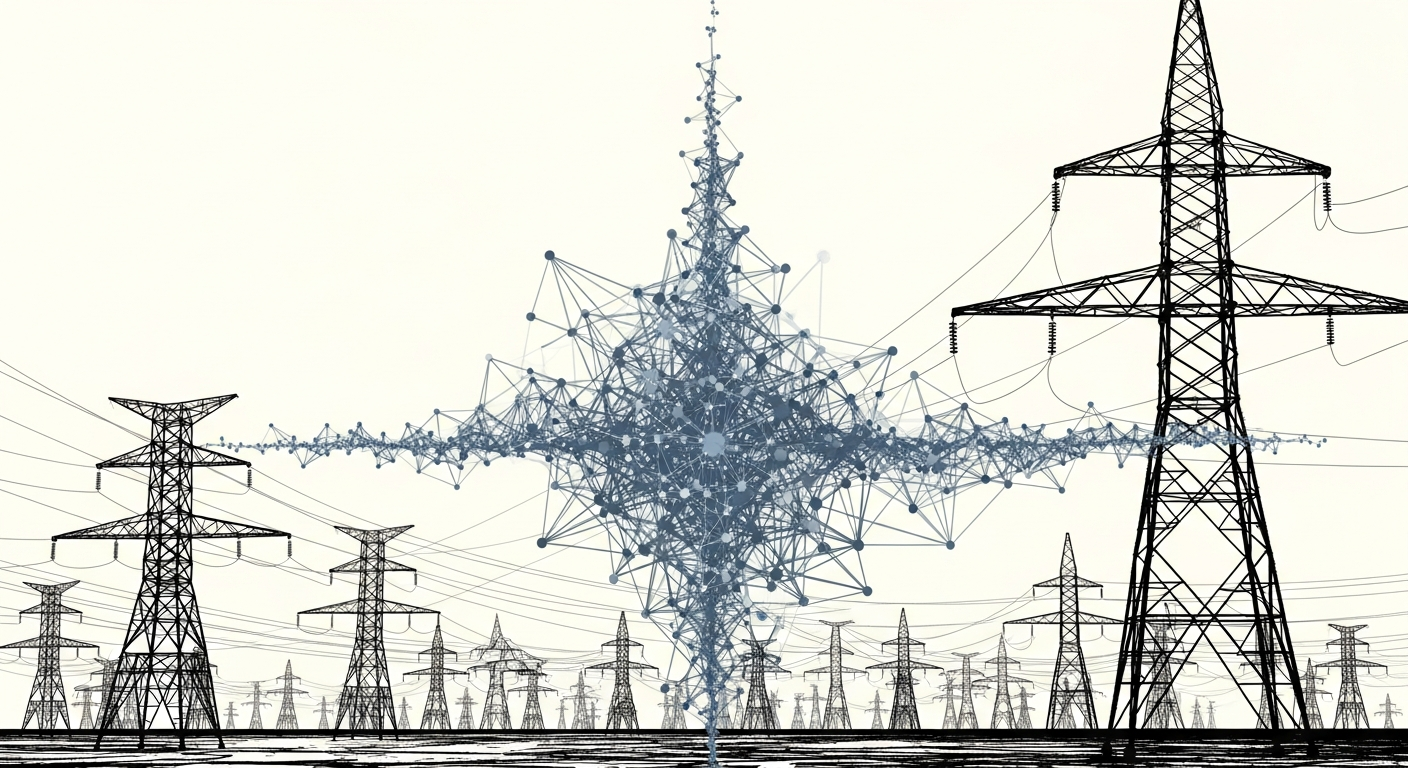
At a Glance
The AI compute buildout is not simply stressing the electrical grid — it is exposing the grid's fundamental architectural assumptions as inadequate for the load profile of a hyperscale inference economy. This article examines the specific engineering bottlenecks: transmission queue paralysis, transformer supply chain fragility, the physics of high-density cooling, and the emerging infrastructure responses — from HVDC topology shifts to on-site nuclear — that are reorienting how industrial power is sourced, moved, and managed. Where prior installments in this series established the macro demand picture, this piece descends into the technical layer.
I. The Premise: A Century-Old Infrastructure Meets a New Demand Regime
The electrical grid was not designed for AI. That sentence sounds like hyperbole until you examine what the grid was actually designed for: a century of gradual, geographically distributed, and relatively predictable load growth driven by homes, factories, and office buildings. Demand planners working in that paradigm could model decades forward with reasonable confidence. Load grew at a pace that capital investment cycles could track.
The hyperscale AI era has broken every assumption embedded in that planning model simultaneously.
Consider what a dense modern AI compute rack actually represents. A single NVIDIA H100 GPU draws approximately 700 watts at full load. A rack of eight H100s generates 5.6 kilowatts from compute alone, before accounting for networking, storage, and cooling overhead. The emerging GB200 NVL72 configuration pushes rack-level power into the 120–130 kW range — a four-to-six-fold density increase over the previous generation, arriving within a two-to-three year window. [NVIDIA GB200 NVL72 Product Brief, 2024]
Scale that density across a hyperscale campus of tens of thousands of racks, and the resulting load profile looks less like a factory and more like a mid-sized city materializing at a specific grid interconnection point — rapidly, with minimal advance notice, and demanding power that is continuous rather than cyclic.
The aggregate numbers anchor this reality. Global data center electricity consumption stood at approximately 460 TWh in 2022. The IEA's analysis projects that figure could exceed 1,000 TWh by 2026 — a consumption level roughly equivalent to Japan's entire national electricity output. [IEA Electricity 2024 Report] In the United States specifically, data centers consumed approximately 200 TWh in 2022, representing around four percent of total national electricity use. [Shehabi et al., Lawrence Berkeley National Laboratory, LBNL-1005775, 2016]
Note on a widely-cited projection: A figure suggesting U.S. data center consumption could reach six to twelve percent of national electricity use by 2028 under high-growth AI scenarios has circulated extensively in industry reporting and is attributed to Lawrence Berkeley National Laboratory. Our research team could not confirm the specific post-2022 LBNL document containing this projection, and it must be treated as unverified until confirmed against current LBNL publications. It has been excluded from the analysis below on that basis.
The corporate-level signals corroborate the directional trend regardless. Google's total electricity consumption grew by approximately seventeen percent year-over-year in 2023, driven predominantly by AI infrastructure, and the company acknowledged it had moved away from prior carbon-neutral commitments. [Google 2024 Environmental Report] Microsoft's carbon footprint increased by approximately twenty-nine percent between 2020 and 2023, with Azure AI infrastructure cited as a primary driver. [Microsoft 2024 Environmental Sustainability Report]
These are not projections. They are reported actuals from companies with every incentive to understate the figures.
This article extends the foundational demand analysis established in the two prior pieces in this series (Argus scores 91 and 88), which examined macro consumption trends and the limitations of renewable power purchase agreements as a scaling strategy. The analysis here descends into the specific engineering and infrastructure layers those pieces introduced — the physics, the patents, and the architectural departures that represent genuine paradigm shifts rather than incremental optimization.
II. The Transmission Problem Nobody Is Talking About Loudly Enough
The instinctive response to an electricity demand crisis is to build more generation. That instinct is understandable but, in the current environment, partially misdiagnosed. The United States does not face a generation crisis alone. It faces a transmission and interconnection crisis that is structurally distinct from — and in some ways more intractable than — the generation gap.
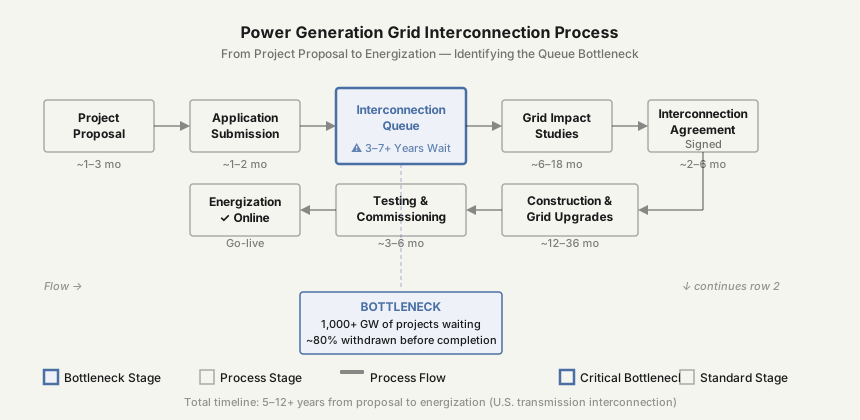
The mechanism is concrete. As of early 2024, the U.S. interconnection queue — the process by which new power generation projects secure the right to connect to the transmission grid — contained approximately 2,600 gigawatts of proposed generation capacity, mostly renewables and storage, awaiting grid connection studies and approvals. The median wait time had reached more than five years. [Lawrence Berkeley National Laboratory, Queued Up: Characteristics of Power Plants Seeking Transmission Interconnection, 2024]
Read that again: 2,600 GW of clean energy, ready to be built, sitting in a queue. For context, total current U.S. electricity generating capacity is approximately 1,200 GW. The pipeline contains more than double the existing installed base, and much of it is stranded in bureaucratic process.
FERC Order 2023, finalized in 2023, reformed the queue structure to address the most egregious backlog dynamics, introducing a "first-ready, first-served" cluster study process designed to reduce speculative filings and accelerate legitimate projects. [FERC Order No. 2023, Federal Register Vol. 88, No. 167] Whether those reforms are sufficient to clear the backlog on a timeline relevant to the AI buildout remains an open question.
The practical consequence for hyperscalers is a structural paradox: they can execute power purchase agreements for new renewable generation — and many have done so aggressively — but cannot physically access that power on the two-to-three year timelines their infrastructure construction demands. The signed PPA sits on paper while the data center demands electrons from the existing grid, which in most U.S. markets means a heavier reliance on gas generation than operators' sustainability commitments would prefer.
This is not a policy failure in isolation. It reflects a grid architecture designed for gradual change encountering a demand shock that is neither gradual nor geographically distributed.
III. The Transformer Shortage: A Supply Chain Vulnerability Few Anticipated
Transmission bottlenecks are partly a regulatory and permitting problem. The transformer shortage is a pure supply chain and manufacturing problem, and it is, in some respects, the more immediately acute constraint.
High-voltage transformers are the critical nodes of the transmission system. They step voltage up to transmission levels for long-distance movement of power and back down for local distribution. Without them, new generation cannot reach load centers and new load centers cannot receive generation. They are, functionally, the joints connecting every other part of the system.
The lead times for these components have become genuinely alarming. Standard distribution transformers now carry lead times measured in one to two years. Large Power Transformers — the massive units that anchor high-voltage substations and transmission interconnection points — have historically carried lead times of one to two years in normal market conditions. Updated industry reporting from the 2023–2024 period has cited figures of two to four years or longer, though a comprehensive post-2022 authoritative study from DOE or EPRI requires direct verification before treating that range as planning-grade data. [DOE, Large Power Transformers and the U.S. Electric Grid, Office of Electricity Delivery and Energy Reliability, 2014]
The supply chain geography compounds the risk. The United States manufactures very few large power transformers domestically. Production is concentrated in South Korea, Germany, and increasingly China. For a piece of infrastructure that is literally impossible to substitute — there is no workaround if the transformer does not exist — this geographic concentration represents a category of supply chain risk that the semiconductor shortage made familiar but that the grid community has discussed far less publicly.
For hyperscalers attempting to build gigawatt-scale campuses in two-to-three year windows, the transformer constraint is often the binding physical limit — the item on the critical path that no amount of capital can accelerate past the manufacturing timeline.
IV. The Physics of Cooling: Why Air Is Losing the War
The demand and transmission problems are primarily infrastructure and regulatory challenges. The cooling problem is a physics problem, and physics does not negotiate.

The fundamental constraint is thermodynamic. Air has a volumetric heat capacity of approximately 1,200 joules per cubic meter per degree Kelvin. Water has a volumetric heat capacity of approximately 4,186,000 J/m³·K — roughly 3,500 times higher. [Hamann et al., IBM Research, IEEE Transactions on Components and Packaging Technologies, Vol. 31, No. 1, 2008] For rack power densities below fifteen to twenty kilowatts, forced air cooling is cost-effective and sufficient. Above that threshold, moving enough air to carry away the heat requires fans, ducting, and raised-floor infrastructure that consumes thirty to forty percent of facility floor space and itself draws significant power.
A rack running at 120 kW — the density target for GB200 NVL72 configurations — is simply beyond what air cooling can address economically. The fluid-mechanical math does not close.
Cold Plate Liquid Cooling
The first mainstream response is cold plate liquid cooling: a closed-loop liquid path, typically water-glycol, circulates through a metal plate in direct contact with the chip package. The liquid absorbs heat conductively and carries it to a facility-level heat exchanger for rejection.
Cold plate systems achieve substantially better thermal resistance than air-based heat sinks — the junction-to-coolant thermal resistance for well-designed cold plate systems is considerably lower than for high-performance air cooling. Published research on cold plate technology for high-performance computing provides performance data in this area, though the specific resistance values applicable to the latest H100 and GB200 hardware generations should be verified against current ASME and IEEE literature before treating any specific figure as a planning anchor. [Kaufman et al., Cold Plate Technology for High Performance Computing, ASME InterPACK Conference Proceedings, 2021]
The practical advantage of cold plate cooling is its relative compatibility with existing server architectures — it can be retrofitted into facilities that were air-cooled without complete mechanical redesign, and the coolant loop interfaces with existing building chilled-water infrastructure.
Two-Phase Immersion Cooling
The more radical departure is immersion cooling. Here, the server is submerged entirely in a dielectric fluid — mineral oil for single-phase systems, or engineered fluorocarbons for two-phase systems. The distinction matters enormously. In two-phase immersion, the dielectric fluid boils at the chip surface. The latent heat of vaporization — the energy absorbed during the phase transition from liquid to vapor — carries heat away at a constant temperature with no temperature gradient across the chip. The vapor condenses on cooled coils above the bath and falls back, creating a closed thermosiphon with no moving parts in the cooling circuit itself.
The facility-level efficiency implications are substantial. Research into two-phase immersion cooling at the facility level has found that Power Usage Effectiveness — the ratio of total facility power to IT power — can approach 1.03 for immersion-cooled systems, compared to 1.5–1.6 PUE for conventional air-cooled hyperscale facilities and 1.2–1.3 for best-in-class air-cooled designs. It is important to note that the specific ORNL report attribution for the PUE ~1.03 figure is currently unverified: the figure is consistent with multiple industry and vendor sources, but the precise Oak Ridge National Laboratory technical report cited in the research literature (Regner et al., 2022) requires confirmation against the ORNL technical reports database before that specific attribution can be treated as established. The directional performance advantage of two-phase immersion is well-supported across multiple sources; the specific ORNL figure should be read as indicative rather than definitive until verified.
The 3M Novec Problem
The immersion cooling transition faces a significant supply chain shock that has received inadequate attention. 3M announced it would cease production of its Novec engineered fluid product line by the end of 2025, citing regulatory pressure around PFAS (per- and polyfluoroalkyl substances) compounds. [3M Company, PFAS Discontinuation Announcement, 2022] Novec fluids are foundational to many deployed two-phase immersion cooling systems, chosen specifically for their thermodynamic properties — low boiling points, high latent heat of vaporization, chemical stability, and electrical non-conductivity.
There is no drop-in replacement. PFAS-free alternatives with comparable thermodynamic profiles are an active area of research and development, but the qualification process for new dielectric fluids in production data center environments is not trivial: new fluids must be validated against materials compatibility (elastomers, PCB substrates, solder alloys), confirmed to meet safety and environmental standards, and characterized across the full operating temperature range of the target hardware. That process takes years, not months.
For operators who committed to two-phase immersion as their high-density cooling strategy, this creates a forced migration that is arriving simultaneously with the hardware density transition that made immersion cooling necessary in the first place.
V. The Inference Problem: Why Grid-Responsive AI Has a Structural Ceiling
One of the most technically nuanced dimensions of the AI power problem is the distinction between training workloads and inference workloads, and the fundamentally different grid interaction each implies.
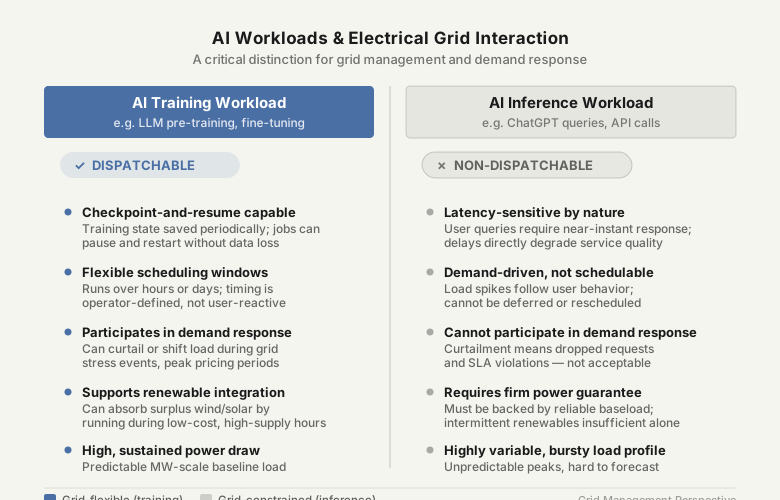
AI training is, in grid management terms, a dispatchable load. Training runs execute over days or weeks, consuming compute at high but predictable rates. Crucially, modern training frameworks implement checkpoint-and-resume — the ability to save the state of a training run to persistent storage at regular intervals and restart from that checkpoint if interrupted. This means a training cluster can, in principle, participate in demand response programs: shed load when grid conditions require, resume when conditions allow, with limited impact on total training throughput.
Research has explored this framework directly. Work published through the ACM on carbon-aware and grid-aware scheduling for large-scale ML training found that shifting GPU utilization toward periods of lower grid carbon intensity and lower demand can achieve meaningful reductions in both emissions and operational cost without material impact on training outcomes. [Wiesner et al., Let's Wait Awhile: How Temporal Workload Shifting Can Reduce Carbon Emissions in the Cloud, ACM SoCC, 2021; Dodge et al., Measuring the Carbon Intensity of AI in Cloud Instances, FAccT 2022] Microsoft's Carbon Aware SDK formalizes this at the software layer, providing APIs for workloads to query real-time grid carbon intensity and make scheduling decisions accordingly. [Green Software Foundation, Carbon Aware SDK, 2023]
This is genuinely promising infrastructure for integrating AI compute into grid demand response frameworks — but its scope is strictly bounded.
Inference serving does not checkpoint. When a user submits a query to a deployed AI model, the response must arrive within latency bounds that range from milliseconds to a few seconds. There is no mechanism by which the serving system can defer that computation to a more grid-friendly moment. The inference cluster must maintain continuous readiness to process unpredictable, asynchronous, latency-sensitive requests. It cannot participate in demand response programs in any meaningful sense.
Speculation: The inference vs. training power split is a critical planning variable for long-run grid impact. Industry commentary frequently suggests that inference will represent the dominant and growing share of total AI power consumption as AI products reach broad deployment scale — the intuition being that training runs occur once while inference runs continuously at consumer scale. However, this split is not currently quantifiable from peer-reviewed literature with methodological rigor, and should be treated as editorial judgment rather than established fact. The research dossier underpinning this article rates this claim as low-confidence and unverifiable at present. What can be said with confidence is that the portion of AI compute that is structurally incompatible with demand response — inference — is unlikely to shrink as a share of total AI electricity demand as AI products mature and user bases grow. The planning implication is that demand response participation is a partial mitigation at best, not a structural solution to the AI power problem.
VI. Nuclear's Return: From Footnote to Load-Bearing Strategy
The prior articles in this series treated hyperscaler renewable PPAs as the primary long-run power strategy and noted their limitations against the interconnection queue problem. The significant new development — and the one with the most profound long-term grid architecture implications — is the pivot to nuclear power as a baseload solution that sidesteps the queue entirely.
The signal event was Constellation Energy's September 2024 agreement with Microsoft to restart Three Mile Island Unit 1 — formally renamed the Crane Clean Energy Center — which had been decommissioned in 2019. The plant is targeted to restart in 2028, providing approximately 835 MW of carbon-free baseload power dedicated to Microsoft's data center operations. [Constellation Energy Press Release, 2024]
This is not a trivial transaction. It is a direct response to the interconnection problem: instead of waiting in a five-year queue for new renewable generation to connect to a congested grid, Microsoft is funding the restoration of existing nuclear capacity that is already interconnected, already permitted, and already known to the grid operator.
The SMR Horizon
The more architecturally disruptive scenario is not grid-scale nuclear but co-located or campus-scale Small Modular Reactors. The hyperscaler activity here has accelerated rapidly.
In October 2024, Google announced an agreement to purchase power from Kairos Power's SMR fleet, targeting first power delivery by 2030 from multiple units totaling up to 500 MW. [Google Blog, Google Signs Agreement with Kairos Power for Advanced Nuclear Energy, 2024] Amazon's Climate Pledge Fund invested in X-energy, whose Xe-100 pebble bed reactor design targets approximately 80 MWe per unit with modular stacking capability. [X-energy Press Release, 2023] NuScale Power's VOYGR platform offers a further design point, with individual module outputs in the range that could serve a large campus-scale load. [NuScale Power, VOYGR SMR Technical Overview, 2023]
The appeal to hyperscalers is not primarily economic — SMR economics at scale remain genuinely unproven and carry substantial first-of-kind risk. The appeal is architectural: SMRs offer supply chain independence from the transmission and interconnection system, site flexibility that allows co-location with or near data center campuses, and the theoretical ability to bypass the FERC interconnection queue for grid-tied power. Some SMR designs can modulate output between a fraction of and full rated capacity, providing a degree of load-following flexibility that large pressurized water reactors cannot economically provide. Note: load-following capability is design-specific and should not be treated as universal across all SMR architectures — the specifics vary significantly and require verification against NRC licensing documentation for each design.
Speculation: If SMR economics improve with serial production — as nuclear advocates argue and as analogies to other complex manufactured systems suggest is plausible — the competitive advantage for hyperscalers who have committed to SMR agreements early could become structural and durable. The capital and timeline required to replicate a diversified nuclear power portfolio is measured in decades, not years, which means the energy infrastructure decisions being made now carry strategic weight that extends well beyond any single product cycle.