Superconducting Digital Logic (SFQ) as a Post-CMOS Path for Datacenter Energy
At a Glance
- The problem SFQ addresses: Global datacenter electricity consumption stood at 260 TWh in 2022, and CMOS's fundamental power profile — continuous charge/discharge cycling, leakage-driven static dissipation — sets a hard floor on how much further conventional silicon can be squeezed.
- The core substitution: SFQ logic replaces the transistor with the Josephson junction, encoding a bit as a quantized pulse of magnetic flux rather than a held voltage. Switching energies land in the attojoule range, with clock rates reaching tens of gigahertz.
- The real bottleneck isn't the transistor's replacement — it's the transistor's neighbor. SFQ logic has run at gigahertz-plus speeds since the 1990s. Cryogenic memory hasn't matured on anything like the same timeline. That gap, more than junction physics, is why there's no SFQ datacenter today.
- Near-term reality: the credible deployment path is workload-specific acceleration co-located with superconducting quantum computers — not general-purpose CPU replacement. Current SFQ chips top out around 10⁵–10⁶ Josephson junctions, against roughly 10¹⁰ transistors in a modern CMOS processor.
- Unresolved and explicitly flagged: no source reviewed for this piece provides a system-level, wall-plug energy comparison between SFQ servers and CMOS servers that accounts for cryocooler load. That absence is itself the central open question in the field.
The Framing Problem With Most SFQ Coverage
Coverage of superconducting computing tends to follow a predictable arc: a device physics result shows switching energy several orders of magnitude below a CMOS transistor, a journalist frames this as datacenters running on near-zero power, and the piece ends without addressing what it costs to hold that device at 4 kelvin. The attojoule number is real. It's just not the story.
The more interesting — and more honestly answerable — question is why, after three decades of RSFQ research producing working gigahertz-class arithmetic circuits, no one has shipped a superconducting server. The answer isn't that Josephson junctions don't switch fast enough or efficiently enough. It's that the field solved the logic problem well before it solved the memory problem, and a computer without adequate memory isn't a computer. That asymmetry — mature logic paired with immature memory — is the actual state of SFQ in 2025, and it's the thread this piece follows.
From Transistor to Josephson Junction
CMOS logic stores a bit as a voltage held on a capacitive node. Reading, writing, and simply maintaining that state costs energy — dynamic power from switching, static power from leakage current that never fully turns off. Single Flux Quantum (SFQ) logic starts from a different physical substrate entirely: a superconducting loop interrupted by one or more Josephson junctions, in which a bit is represented by the presence or absence of a single quantum of magnetic flux, Φ₀ ≈ 2.07 × 10⁻¹⁵ Wb. There's no analog voltage level to hold — data propagates as picosecond-wide pulses whose time-integral is quantized. Switching energy per operation falls in the attojoule range, and clock rates reach tens of gigahertz.
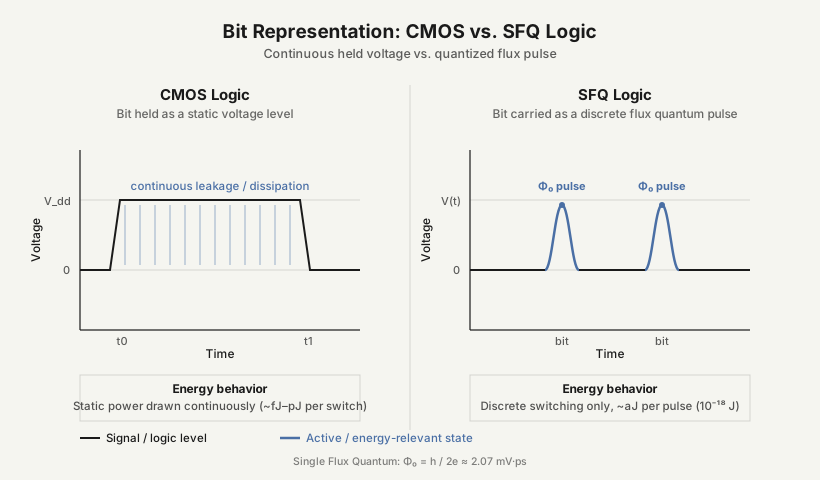
The foundational circuit family, Rapid Single Flux Quantum (RSFQ) logic, has served as the reference architecture for this line of research since the early 1990s. It established the cell library, timing conventions, and fabrication approach — largely niobium-based, operating in the liquid-helium temperature range near 4 K — that most subsequent SFQ work still builds on.
What's changed isn't the physics. It's the metric the field optimizes for. Early SFQ research prioritized clock frequency, chasing the raw-speed advantage a quantized pulse naturally offers. The current wave treats energy-per-operation as the primary figure of merit instead, a shift explicitly driven by the recognition that datacenter power growth under CMOS scaling was becoming unsustainable. That reframing is why the field now talks about ERSFQ and QFP variants rather than simply chasing higher clock rates — and it's the right lens for evaluating whether SFQ actually helps with datacenter energy, rather than just being fast.
The Static-Power Fix: A Preview of How This Field Actually Solves Problems
Classic RSFQ circuits bias each Josephson junction through a resistor network. The switching energy of an individual junction is vanishingly small, but the resistive bias network dissipates power continuously, regardless of whether the junction is switching. At small scale this is a rounding error. At the scale needed for anything resembling a CPU, it dominates total power draw and becomes the practical ceiling on how large an RSFQ chip can grow — a ceiling identified in the scalability literature as the central reason SFQ circuits have historically topped out around 10⁵–10⁶ Josephson junctions per chip, versus the roughly 10¹⁰ transistors routine in a modern CMOS processor.
Energy-efficient RSFQ (ERSFQ) and its close variant eSFQ fix this by replacing the resistive bias network with inductive current biasing. The static dissipation term disappears; the RSFQ cell library, timing methodology, and fabrication process stay largely intact. This isn't a hypothetical patch — it's been demonstrated in concrete datapath building blocks, including an 8-bit ERSFQ parallel binary shifter aimed specifically at superconducting CPU arithmetic.
This pattern — logic family hits a wall, field engineers a fix, cell library survives largely intact — recurs throughout SFQ's history. Worth holding onto, because it sets up the contrast with the memory side of the stack, where no equivalent fix has yet appeared.
Three Logic Families, Three Trade-offs
SFQ isn't a single technology; it's a family of related but distinct approaches, each trading speed against energy differently:
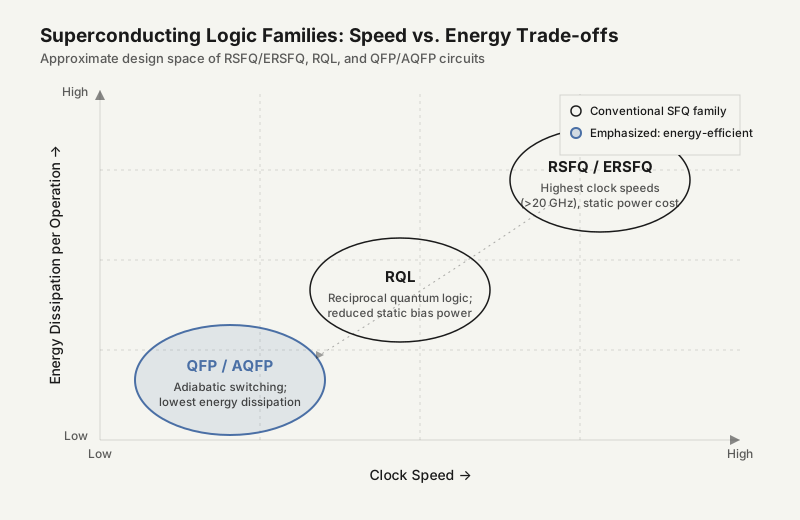
RSFQ / ERSFQ / eSFQ remain the mainstream, highest-clock-rate branch — resistively biased in the original RSFQ formulation, inductively biased in the energy-efficient variants that eliminate static dissipation.
Reciprocal Quantum Logic (RQL) is referenced in the broader landscape as an AC-biased alternative associated with superconducting electronics programs pursuing lower power draw, though specific performance figures for RQL aren't available in the source material reviewed here and shouldn't be asserted beyond that general positioning.
Quantum Flux Parametron (QFP) and its adiabatic variant (AQFP) take the furthest step away from RSFQ's design point: adiabatic, reversible-logic-oriented switching that deliberately trades clock speed for a further cut in energy dissipation. A recent line of work on High-Temperature Superconductor QFP (HTS-QFP) pursues this adiabatic approach in a higher-critical-temperature material system — notable because, if it scales, it would ease the cryogenic burden relative to niobium-based processes that require the full liquid-helium temperature range.
The QFP/AQFP branch matters for reasons that go beyond raw efficiency, which the speculation section below addresses directly.
The Actual Bottleneck: Density, Tooling, and Timing Closure
The gap between demonstrated SFQ integration density (~10⁵–10⁶ junctions per chip) and what a general-purpose processor requires (~10⁹–10¹⁰ equivalent devices) is repeatedly framed in the scalability literature as the central open problem for general-purpose superconducting computing — distinct from, and in addition to, the energy question.
Closing that gap requires infrastructure the field is still building. SFQmap, a technology-mapping tool for SFQ logic circuits, targets automated synthesis for SFQ cell libraries — the superconducting analog of standard-cell EDA flows that CMOS designers have relied on for decades. Without tooling like this, SFQ circuits remain hand-crafted, small-scale demonstrators rather than designs that can scale the way CMOS chips do.
Timing closure poses a related, SFQ-specific problem with no direct CMOS analog: because SFQ signaling is pulse-based rather than level-based, clock skew doesn't just slow a circuit down — it can cause outright pulse loss. Recent work on delay balancing with clock-follow-data techniques addresses exactly this, optimizing area/delay trade-offs to make RSFQ circuits more physically robust against skew-induced failures. Clock distribution itself is under active revision too: multiphase clocking schemes for SFQ systems are being investigated to improve throughput and reduce the routing overhead of delivering precisely-timed flux pulses across a chip, rather than a simple voltage edge.
None of this signals a field that's stuck. It's a field doing, in the 2020s, the kind of unglamorous infrastructure-building that CMOS did in the 1980s and 1990s — and that work is a leading indicator of when (not whether) junction density ceilings start moving.
Where the Government Money Went, and What It Revealed
A large share of the applied SFQ CPU research in circulation today traces back to IARPA's Cryogenic Computing Complexity (C3) program, a U.S. intelligence-community research effort aimed at building a superconducting computer prototype with substantially better energy efficiency than CMOS at comparable performance. C3's structure was explicitly phased: Phase 1 focused on demonstrating core logic, memory, and interconnect building blocks separately, before any attempt at a small-scale integrated system.
The detail that matters most for this article's argument is what C3 treated as a distinct sub-problem from the start: cryogenic memory. HYPRES was awarded a subcontract specifically to develop a cryogenic memory solution for the program — a structural signal, from inside a well-funded federal research effort, that superconducting logic's gigahertz clock rates were already ahead of superconducting memory's practical density and access-time maturity. That subcontract wasn't a footnote. It was an acknowledgment that the compute half of the SFQ problem was tractable enough to treat as a solved-ish engineering domain, while memory needed its own dedicated research track.
NIST's parallel work on scalable, high-speed digital SFQ circuits reflects the same division of labor at the standards-and-metrology level: closing fabrication and characterization gaps for logic is treated as separate, better-understood territory from the memory question.
The Memory Gap: Why This Is the Real Story
Here's the asymmetry worth sitting with. RSFQ logic has produced working gigahertz-class shift registers, arithmetic logic units, and up-down counters using established design patterns since the 1990s. Every time the logic side hit a wall — static power, timing closure, clock distribution — the field found an engineering fix that preserved the existing cell library and kept moving. The RSFQ-to-ERSFQ transition is the clearest example: same design methodology, static power term removed.
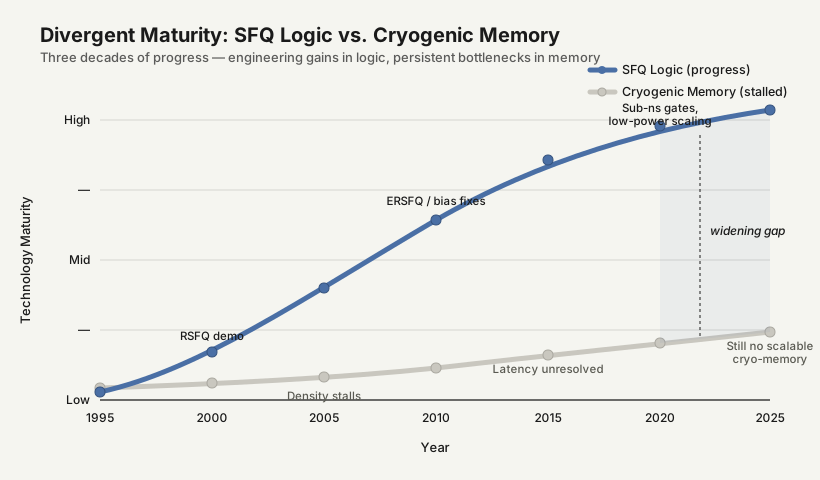
Memory has had no equivalent breakthrough. The patent record corroborates this directly. A continuation family of patents — U.S. 9,887,000, then 10,460,796, then 10,950,299, spanning roughly 2018 through 2021 — claims a hybrid architecture combining RSFQ-family logic with magnetic (spintronic) memory elements operating at cryogenic temperature, with claims describing target clock speeds up to 100 GHz. The fact that this is a hybrid architecture, and that the same underlying specification was refined across three successive filings over three years, indicates sustained claim-building around solving the memory integration problem specifically — not logic speed or density in isolation. Nobody is filing continuation patents to make Josephson junctions switch faster. They're filing them to make cryogenic memory work at all.
This is why a 10⁵-junction SFQ chip doesn't scale to CPU-class integration even where junction fabrication itself isn't the constraint: there's nowhere adequate to put the data. A processor without dense, fast, cryogenic-compatible memory is an arithmetic demonstrator, not a computer. Future coverage of SFQ progress should track cryogenic memory density and access latency as closely as — arguably more closely than — logic advances, because memory is the pacing item for any full-system SFQ computer.
The Interfacing Problem Nobody Gets to Skip
Even a fully solved SFQ logic-and-memory stack doesn't produce a standalone datacenter node. I/O, storage, and networking to the outside world remain semiconductor-based and operate at room temperature. The interconnect between a 4 K SFQ die and warmer CMOS control and readout electronics is consequently a first-order system design problem, not an integration afterthought — a distinction the research literature treats explicitly rather than glossing over.
This mirrors a bottleneck familiar from an adjacent field: the "wiring problem" that dilution-refrigerator-based quantum computing control stacks already contend with, where every signal that has to cross the boundary between cryogenic and room-temperature electronics carries a thermal and latency cost. SFQ-CMOS interfacing and quantum control wiring are, in effect, the same engineering problem wearing two different hats.
Where SFQ Is Actually Headed First
The pattern across recent adjacent-application research is consistent, and it points away from general-purpose computing as the near-term entry point. Several concrete examples:
- C3-VQA, a cryogenic SFQ-based co-processor for variational quantum algorithms, runs classical control and optimization loops physically co-located with — and at the same temperature stage as — superconducting qubits.
- NEO-QEC and QECOOL both apply SFQ-adjacent decoders to surface-code quantum error correction, exploiting SFQ's raw switching speed for the low-latency decode loop that superconducting quantum processors require.
- Deep neuromorphic network research explores SFQ pulses as a natural substrate for event-driven, spiking-neural-network-style computation.
- An efficient superconducting arithmetic logic unit demonstrates ultra-fast computing primitives directly relevant to a hypothetical SFQ CPU datapath, even absent a full system around it.
The common thread: every one of these is a case where the surrounding hardware is already cryogenic for independent reasons — usually because it's a superconducting quantum processor. SFQ control and decode electronics avoid both the heat load of room-temperature control racks reaching down into a dilution refrigerator and the latency penalty of signals traveling out of and back into one. That's a materially different value proposition than "SFQ replaces the x86 server in row 12." Framing SFQ's near-term relevance around general-purpose CPU replacement overstates the current state of the art given the junction-density ceiling documented above; framing it around quantum-adjacent acceleration matches what the research base actually shows.
Risk Assessment
Laid out plainly, the barriers facing SFQ as a datacenter technology fall into a few clear categories, each with a different character and a different plausible fix:
Scalability ceiling — high severity. The technical barrier is integration density and fabrication complexity; the market barrier is that a chip topping out in the 10⁵–10⁶ junction range simply doesn't support general-purpose CPU workloads. Mitigation is underway in the form of EDA tooling (SFQmap) and advanced clocking schemes, but this is a multi-year maturation process, not a near-term fix.
Cryocooler overhead — high severity, and the least resolved item on this list. The technical barrier is the energy cost of continuous refrigeration and its effect on system-level power usage effectiveness; the market barrier is straightforward economic viability for general datacenter use. No retrieved source in the current research base provides a wall-plug, cryocooler-inclusive energy comparison against CMOS at equivalent throughput — this is flagged as an open question rather than resolved in either direction, and any claim that SFQ definitively wins or loses on total system energy should be treated with suspicion until that comparison exists. Higher-operating-temperature materials work (HTS-QFP) and workload-specific co-location are the two mitigation paths currently visible.
Cryogenic memory bottleneck — high severity, and the argument this article has centered on. Memory density and access latency, and their integration with SFQ logic, remain unresolved in a way logic itself is not. Hybrid architectures combining superconducting logic with magnetic memory, and dedicated R&D efforts like the HYPRES C3 subcontract, are the visible mitigation attempts.
SFQ-CMOS interfacing — medium severity. Signal conversion, thermal management, and wiring complexity increase system cost and complexity, but shared engineering efforts with the quantum computing control-stack community and specialized interconnect research are actively chipping away at this.
EDA tooling immaturity — medium severity. The lack of mature automated synthesis and unresolved timing-closure challenges slow design iteration and raise non-recurring engineering costs. Tools like SFQmap and continued clocking-scheme research are the direct response.
Fabrication yield and reliability — medium severity. Josephson junction manufacturing consistency, pulse loss, and metastability affect device reliability and cost. Clockless circuit architectures — including a recent patent targeting metastability-free clockless SFQ logic specifically — and improved fabrication processes from standards bodies like NIST are the mitigation path.
Taken together, these six risks sort into two tiers: things the field has a demonstrated playbook for fixing (static power, timing closure, metastability), and things it doesn't yet (cryocooler overhead at system scale, memory density). That distinction should inform how much weight any single optimistic milestone deserves.
Speculation: What the Next Five to Ten Years Plausibly Look Like
The following section extends beyond directly demonstrated results into trajectories the dossier's research base supports as plausible, not certain. It is explicitly speculative.
Speculation: near-term deployment (roughly three to five years) is workload-selective, not general-purpose. The clearest, most defensible prediction supported by current research momentum is that SFQ's first production footprint will be as a co-located accelerator for superconducting quantum computers — control electronics, error-correction decoders, and similar low-latency, high-speed niche functions — rather than anything resembling a CMOS server replacement. This is where the confirmed research activity (C3-VQA, NEO-QEC, QECOOL) is concentrated, and it sidesteps the two hardest open problems (cryogenic memory density, system-level cryocooler economics) by exploiting infrastructure that's already cryogenic for other reasons.
Speculation: EDA tooling maturation, on a three-to-seven-year horizon, will likely gate scaling more than any single device-physics breakthrough. Tools like SFQmap represent the early stage of automated design infrastructure that CMOS has had for decades. The pace at which this tooling matures is itself a rate-limiting factor for how quickly SFQ circuit scale can grow past the current ~10⁵ junction ceiling — independent of whether junction fabrication itself improves.
Speculation: adiabatic and reversible logic (AQFP, HTS-QFP) represent the longer horizon — five to ten years — toward a qualitatively different efficiency ceiling. Because adiabatic switching in principle allows energy dissipation per operation to approach the Landauer thermodynamic minimum, rather than being bounded by a fixed attojoule-scale switching energy, this branch of research isn't simply an incremental improvement on RSFQ/ERSFQ — it's aimed at a different physical limit entirely. If HTS-QFP research succeeds in raising the practical operating temperature of adiabatic superconducting logic, it would independently ease the cryocooler-overhead burden that sits atop this article's risk list, making it a genuinely complementary technology track rather than a competing one. No source reviewed here provides a specific measured figure for how close HTS-QFP implementations currently sit to the Landauer limit — the directional claim is well-established superconducting-electronics theory, but the quantitative gap remains an open research question.
Speculation: the thermal-logic alternative is a hedge, and its existence is itself informative. A parallel research track proposing attojoule-to-femtojoule-class superconducting thermal logic and memory — using thermal rather than magnetic-flux state variables in superconducting nanowires — targets the same energy-per-bit-operation regime as Josephson-junction SFQ, but through an architecturally distinct mechanism. Its emergence suggests the field itself isn't fully confident that Josephson-junction fabrication yield is a solved problem; serious researchers are actively hedging against that risk with an alternative physical substrate. That's a more candid signal about the field's internal uncertainty than most consumer-facing coverage acknowledges.
Where This Leaves the Datacenter Energy Question
SFQ logic is not a near-term fix for the 260 TWh (2022) global datacenter electricity bill. The honest version of the story is narrower and more useful than "superconductors could slash datacenter power": SFQ has had working, fast, reasonably energy-efficient arithmetic logic for three decades, refined through a consistent pattern of engineering fixes to static power, timing closure, and clock distribution. What it has never had is a cryogenic memory technology mature enough to pair with that logic at CPU scale — a gap federal research programs identified and tried to address separately as far back as the mid-2010s, and one that current patent activity is still visibly working through.
The nearest plausible commercial footprint isn't a datacenter server rack. It's control and decode electronics bolted onto superconducting quantum computers that are already cryogenic, where SFQ's speed and low switching energy solve a real, immediate problem without requiring anyone to first solve cryogenic memory at scale. Whether SFQ ever becomes a genuine datacenter-energy technology, rather than a quantum-computing accessory, depends on two things this dossier's research base cannot yet answer: whether cryogenic memory closes the gap logic already closed for itself, and whether anyone produces the wall-plug, cryocooler-inclusive energy comparison against CMOS that, as of this writing, simply does not exist in the public research record.
This article is part of ongoing coverage of post-CMOS computing architectures. The cryocooler-overhead question raised here connects directly to broader datacenter Power Usage Effectiveness and cooling-infrastructure coverage — SFQ effectively proposes trading air or liquid cooling overhead for cryogenic refrigeration overhead, a trade worth weighing against conventional cooling trends directly. The adiabatic/reversible logic thread (AQFP, HTS-QFP) opens toward a dedicated treatment of reversible computing and the Landauer limit as a general post-CMOS strategy, independent of any single materials system. And the pattern seen here — deep-tech capability seeded by DARPA/IARPA-style government programs years before commercial patent activity follows — is a recurring shape worth tracking across other frontier hardware beats as they mature.