The Conversion Boundary: 480V AC and 800V DC in the Gigawatt AI Datacenter
A grid-to-core analysis of where alternating current stops and direct current begins—and why that line is moving.
At a Glance
For most of the datacenter era, the question of how power reached a server was settled well enough to be boring. Utility feeds arrived, a facility distributed alternating current at conventional voltages, and racks pulled what they needed. The interesting engineering happened in the silicon, not the busbar.
The AI rack broke that settlement. As per-rack power scales from tens of kilowatts toward roughly one megawatt, the physics of moving current through copper has become a first-order architectural constraint. The industry's response is a coordinated shift in two places at once: a move from 48V rack-internal DC distribution—the standard of the roughly 2019 Open Compute era—toward 800V DC inside the next generation of racks, layered on top of the conventional 480V three-phase AC that feeds North American facilities.
This piece isn't another argument that 800V DC is coming. That case has been made, repeatedly, by the vendors building the hardware. The more useful question—and the one existing coverage leaves unanswered—is where the conversion happens. Somewhere between the utility transformer and the accelerator package, AC becomes DC and one voltage becomes another. That boundary isn't dictated by physics alone. It's an engineering choice, and it carries consequences for efficiency, copper mass, fault protection, and how a gigawatt-class site behaves as a grid citizen.
This is a companion to our earlier deep dive ["800VDC Power Distribution in the AI Datacenter: Rack-Scale Architectures Beyond 48V"], which established the rack-internal case for abandoning 48V. Here we extend that thesis upstream—into the 480V facility layer—and outward, to the gigawatt site.
Why 48V Ran Out of Room
The argument for higher voltage is one of the cleanest in electrical engineering, which is why it recurs at every step-change in power density. At constant power, current is inversely proportional to voltage: P = VI. Resistive loss in a conductor scales with the square of current: P_loss = I²R. Halve the current by doubling the voltage, and resistive loss falls to a quarter.
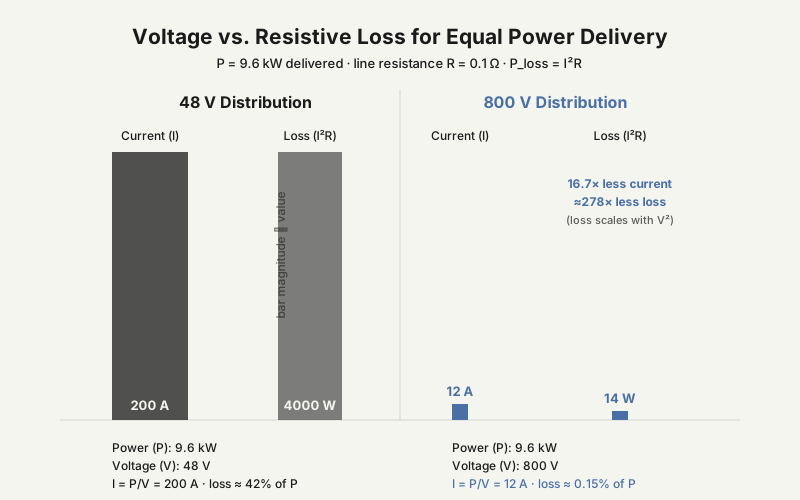
At 48V, delivering meaningful power means delivering enormous current. A rack drawing tens of kilowatts already pushes hundreds of amps through its internal distribution. A rack approaching one megawatt at 48V would demand current in a range that no practical busbar can carry—not without either unacceptable losses or a quantity of copper that's uneconomic, heavy, and physically difficult to route.
That heat current generates has to go somewhere. It competes directly with the thermal budget already consumed by the accelerators themselves.
That's the wall 48V hit. The response—moving rack-internal distribution to 800V DC—is the same lever the industry has always pulled, just applied at a larger scale. Both NVIDIA and Schneider Electric frame 800V DC explicitly as the enabler for the one-megawatt rack, positioning it as the direct successor to 48V rather than an incremental adjustment.
Two data points anchor how fast this has moved. The legacy 48V rack DC standard dates to roughly 2019. The 800V DC rack distribution voltage arrived as a defined target in 2025, with the first productized 800V DC Power Rack for AI Datacenters launching in 2026 through Flex, built to align with NVIDIA's roadmap.
That's a remarkably compressed transition for physical infrastructure—a sign that the forcing function here is the accelerator roadmap, not a leisurely evolution of facility practice.
The Boundary Nobody Draws
Here's where the existing literature splits into two halves that never quite meet. On one side sit the vendor and news accounts—NVIDIA's architecture blog, Schneider's infrastructure framing, the reporting on NVIDIA's partner ecosystem, Flex's product launch. These describe 800V DC from inside the rack. They're authoritative on the destination and largely silent on the journey.
On the other side sits grid-facing academic work. A 2025 arXiv framework analyzes gigawatt-scale AI datacenters as dispatchable grid assets, using Virtual Power Plant Control Systems for Datacenters to manage their integration with the utility across multiple timescales. That work treats the facility from the utility side and never descends to the rack.
Between these two vantage points lies the entire internal power chain—and the single decision that governs its efficiency: where does 480V AC stop, and where does 800V DC begin?
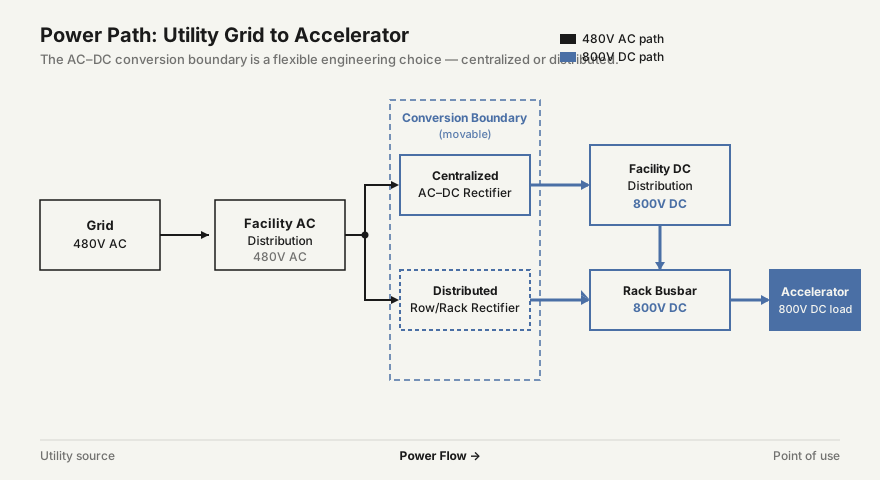
Consider the path. Power arrives from the grid. In a conventional North American facility it's distributed as 480V three-phase AC—the workhorse voltage of industrial and datacenter power. At some point that AC must be rectified to DC and delivered to the rack at 800V. The question is at what point.
Centralize the rectification—converting 480V AC to 800V DC at a facility or room level and distributing DC across the floor—and the DC network carries the benefits of high-voltage, low-current transport across longer runs. But the site takes on a large, centralized DC infrastructure, with all the fault-protection challenges that implies.
Push rectification toward the row or the rack instead—via sidecar power shelves that take in AC and hand off DC over short distances—and the high-current penalty is confined to the last few meters. The cost this time is conversion hardware and its heat, distributed throughout the floor.
Physics doesn't answer this one on its own. It's a trade among copper mass, conversion-stage count, thermal placement, and protection complexity.
The industry's own materials on grid-to-core architecture describe the chain, but they tend to treat the conversion point as a given rather than a lever. It's the lever.
A note on grounding: the specific topology choices various integrators are making—centralized versus row-level rectification—are described across industry technical sources, but the precise placement decisions were not verifiable to primary specification in the research underlying this article. We describe the trade space; we do not assert a single winning topology, because the evidence does not yet support one.
Fewer Conversions, or More?
Every conversion stage in the chain costs efficiency and adds hardware that can fail. So the instinct is to minimize conversions. High-voltage DC distribution is attractive partly because it can remove stages: a DC distribution bus running at 800V aligns naturally with other DC sources on a modern site.
This is where the gigawatt-scale picture and the rack-scale picture finally connect. The arXiv virtual-power-plant framework describes gigawatt facilities behaving as dispatchable grid assets—sites that can modulate their draw and lean on on-site storage. Battery systems and solar arrays are natively DC.
A facility whose internal distribution is already DC can interface with those DC sources across fewer conversion stages than an AC-distributed one. So the internal architecture choice and the grid-interface strategy aren't independent problems. The conversion boundary you choose inside the building shapes how gracefully the building can act as a grid resource outside it.
There's also a supply-chain dimension working in the industry's favor. 800V isn't a novel voltage that datacenter engineers must pioneer from scratch. It's already the mainstream operating voltage of electric-vehicle powertrains—which means a mature ecosystem of high-voltage power semiconductors already exists.
Speculation: If the datacenter industry can leverage the existing 800V power-electronics supply chain built for electric vehicles, the cost curve for HVDC conversion hardware could compress faster than a purely datacenter-specific component would allow.
This trajectory is plausible given that 800V is an established EV powertrain voltage and that the transition to productized 800V DC racks has already moved from target (2025) to shipping product (2026).
We flag it as speculation because the specific degree of supply-chain reuse and its cost impact were not independently verifiable in the underlying research. The direction is well-founded; the magnitude is not yet established.
The Real Constraint Is Not Voltage. It's Interruption.
If the case for 800V DC is so clean, why isn't the entire chain already DC end to end?
The honest answer: the hard problem in DC distribution isn't moving the power—it's stopping it.
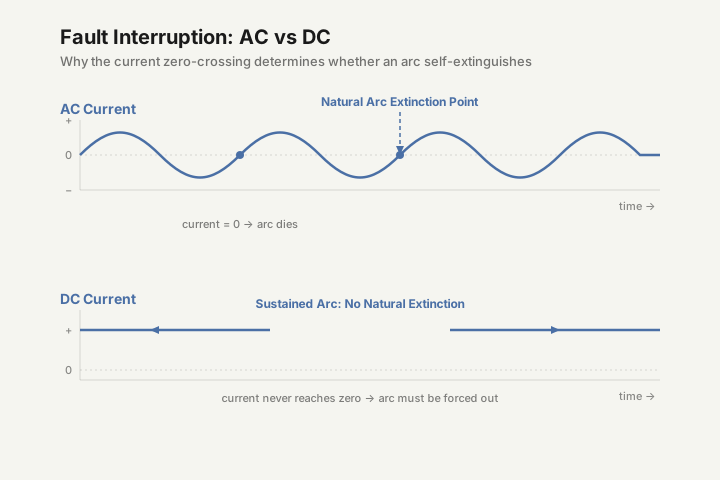
Alternating current crosses zero volts twice per cycle. That natural zero-crossing is what a conventional AC circuit breaker exploits to extinguish an arc—the current cooperatively passes through zero, and the arc dies.
Direct current offers no such courtesy. An 800V DC fault produces a sustained arc with no natural extinction point, and interrupting it demands fundamentally different protection technology—solid-state and semiconductor-based rather than electromechanical.
This is the true rate-limiter on how far and how fast the DC boundary can advance across the chain.
Building an 800V DC rack today is entirely possible; Flex is shipping one. Building out large-scale, centralized 800V DC distribution across a gigawatt floor—with fault protection engineers trust to the same standard as a century of AC breaker practice—is a different and harder thing.
The maturity of solid-state DC circuit protection, more than any efficiency curve, is likely to determine where the conversion boundary settles in the near term.
It's also why we expect the boundary to migrate toward the rack before it migrates away from it: confining DC to short, well-characterized runs inside the rack limits the fault-protection surface area while the protection technology matures.
We'll return to this in a dedicated follow-up, ["Solid-State DC Protection: The Circuit Breaker Problem Holding Back 800VDC AI Racks"], because it deserves treatment on its own terms rather than as a footnote to the distribution story.
What This Means for the People Building It
For the architect designing a next-generation AI hall, the practical takeaways are these.
First, treat the conversion boundary as a design variable, not an inherited constraint. The decision of where 480V AC becomes 800V DC propagates through your copper budget, your thermal plan, your fault-protection strategy, and your ability to integrate on-site storage. It deserves to be reasoned about explicitly and early.
Second, recognize that this is a multi-vendor transition, not a single-vendor product. NVIDIA is coordinating with power-delivery partners rather than shipping the system alone, and independent integrators such as Flex are productizing racks against that roadmap. The architecture is coalescing as an ecosystem—which means interoperability and sourcing flexibility are realistic to plan around.
Third, don't decouple this from cooling. A one-megawatt rack can't be air-cooled. HVDC distribution and direct-to-chip or immersion liquid cooling are structurally coupled transitions—two faces of a single rack-scale re-architecture.
Any power plan that doesn't arrive alongside a thermal plan is incomplete.
The comfortable era in which datacenter power was a solved substrate beneath the interesting work is over. The substrate is now the interesting work.
The 48V-to-800V shift is settled in direction; the open engineering lies in the boundary—where alternating current yields to direct, how few times the power is converted on its way to the accelerator, and whether the protection technology can keep pace with the voltage.
Those are the questions worth watching. And they're only beginning to be answered.
This article extends our earlier rack-scale analysis ["800VDC Power Distribution in the AI Datacenter: Rack-Scale Architectures Beyond 48V"] and sets up a forthcoming deep dive on ["Solid-State DC Protection: The Circuit Breaker Problem Holding Back 800VDC AI Racks"].
Sources
- NVIDIA, "800 VDC Architecture Will Power the Next Generation of AI Factories," NVIDIA Developer Blog (2025).
- Schneider Electric, "The 1 MW AI IT Rack Is Coming, and It Needs 800 VDC Power" (2025).
- DatacenterDynamics, "Nvidia Working With Data Center Partners to Build 800V HVDC Power Systems" (2025).
- Flex, "Flex Launches 800 VDC Power Rack for Next-Generation NVIDIA AI Infrastructure" (2026).
- SemiAnalysis, "Vera Rubin – Extreme Co-Design: An Evolution from Grace Blackwell Oberon" (2025).
- "A Theoretical Framework for Virtual Power Plant Integration with Gigawatt-Scale AI Data Centers: Multi-Timescale Control and Stability Analysis," arXiv:2506.17284 (2025).
- RAND Corporation, "AI's Power Requirements" (Pilz, Mahmood, Heim, 2025).
- EE Power, "AI Datacenter Grid-to-Core Power Architecture" (2025).
Stay in the loop. Project Isocline publishes deep-dive technical analysis on AI infrastructure, energy systems, and the engineering decisions shaping the next decade of compute. No noise. No fluff. Subscribe to the newsletter → You can unsubscribe at any time.