Sparse and Structured Attention Accelerators for On-Device Long-Context Edge Inference
At a Glance
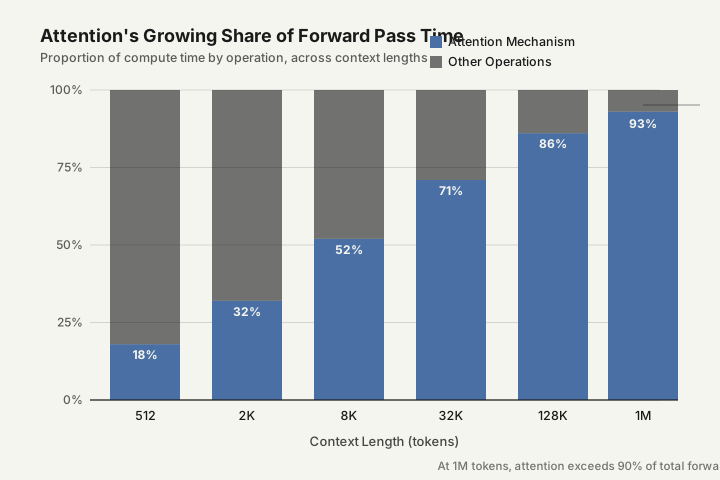
- Attention's quadratic cost isn't just a training-time inconvenience anymore — at million-token context lengths, it eats up over 90% of total forward-pass time, according to Alibaba's Qwen2.5-1M Technical Report.
- Two co-designed strategies dominate the research landscape right now: algorithmic sparsity (deciding which tokens actually matter) and hardware-algorithm co-design (building silicon that executes those decisions natively, without overhead).
- On-device deployment flips the priorities of datacenter research on their head. Edge accelerators aren't chasing raw throughput; they're fighting DRAM bandwidth ceilings, SRAM capacity limits, and power budgets that run one to two orders of magnitude tighter than a GPU's.
- The reported gains are substantial and specific: SpARC hits 85–90% attention-map sparsity with negligible accuracy loss; SALO reports 17.66× speedup versus GPU and 89.33× versus CPU; H2EAL claims 5.20–48.21× speedup and 6.22–73.48× energy efficiency improvement; IntAttention delivers up to 3.7× speedup and 61% energy reduction over FP16 baselines on plain Arm CPUs — no dedicated NPU required.
- The next inflection point isn't a single breakthrough. It's convergence: sparsity, extreme quantization, and compute-in-memory are starting to stack in the same silicon.
Why Attention Breaks First on Edge Silicon
Every discussion of transformer inference eventually arrives at the same uncomfortable fact: standard self-attention requires every query token to compare itself against every key token. Double the context, and you quadruple the work. That's been common knowledge since the earliest scaling critiques of the transformer architecture. What's changed is where the pain actually shows up.
In datacenter serving, the quadratic cost gets absorbed by high-bandwidth memory, large SRAM scratchpads, and power budgets measured in kilowatts per rack. On a phone, a wearable, or an embedded SoC, none of those buffers exist. LPDDR bandwidth is a fraction of HBM's. On-chip SRAM is precious. And the power envelope is measured in single-digit watts, not hundreds. The result: the same algorithmic bottleneck becomes proportionally far more punishing at the edge — and that's before you factor in that "long context" on-device usually means something more ambitious than a typical cloud request. Think multi-document retrieval, on-device agents parsing long histories, or wearables processing continuous sensor streams.
The scale of the problem isn't hypothetical, either. Alibaba's own engineering team, describing production deployment of their Qwen2.5-1M model, found that at million-token input lengths, the attention mechanism alone accounts for over 90% of total forward-pass time. That statistic comes from a cloud-serving context, but it's directionally even more severe on constrained hardware, where the fallback strategies available to a datacenter GPU — bigger batches, more HBM, kernel fusion across many streaming multiprocessors — simply don't exist.
This is the problem sparse and structured attention accelerators exist to solve. Not by making attention faster in the abstract, but by making the hardware and the algorithm agree in advance on which query-key pairs are even worth computing.
The Two Threads: Algorithmic Sparsity and Hardware Co-Design
It's useful to split the research landscape into two threads that increasingly collapse into each other.
Algorithmic sparsity reduces the set of computations that need to happen — deciding, before or during inference, which tokens or blocks of the attention matrix can be safely skipped. Hardware-algorithm co-design builds accelerators — spatial arrays, systolic structures, compute-in-memory macros — that execute those sparsity decisions without paying the overhead of translating an irregular, dynamic pattern into a general-purpose processor's rigid execution model.
The field's clearest articulation of why these threads need to merge comes from DeepSeek's Native Sparse Attention (NSA), which frames the goal explicitly as achieving "substantial speedups through arithmetic intensity-balanced algorithm design, with implementation optimizations for modern hardware" — while remaining natively trainable end-to-end, rather than bolted on after the fact. NSA's kernel is built around an awareness of the memory hierarchy that most algorithm papers simply ignore: it "loads queries by GQA groups (Grid Loop), fetches corresponding sparse KV blocks (Inner Loop), and performs attention computation on SRAM" — a design that explicitly distinguishes what lives in fast on-chip memory from what has to traverse slower HBM. The results back this up: NSA-trained models matched or exceeded full-attention baselines across general benchmarks, long-context tasks, and instruction-based reasoning, all while achieving meaningful decode and prefill speedups at 64K-token sequence lengths.
NSA was built for datacenter training and inference — it doesn't address edge power or DRAM bandwidth constraints directly. But its central lesson — that sparsity patterns must be designed with the memory hierarchy, not layered on top of it after the algorithm is already fixed — is the organizing principle behind nearly everything discussed below.
Prefill vs. Decode: Two Different Bottlenecks Wearing One Name
Here's a distinction that's easy to gloss over but essential for understanding edge accelerator design: "attention" isn't one workload. It's two, with different bottlenecks entirely.
Prefill — processing the initial prompt — is compute-bound. You're doing one large, mostly-parallel matrix computation. This is the phase Microsoft Research's MInference 1.0 targets directly, using dynamic sparse attention patterns identified per-head at runtime specifically to accelerate this expensive front-loaded step. It's not just an academic exercise, either: Alibaba's Qwen2.5-1M team adopted MInference in production, "implement[ing] a sparse attention mechanism based on MInference... to accelerate the prefill phase," layering in chunked prefill and a sparse refinement method to manage the resulting accuracy trade-off.
Decode — generating tokens one at a time against an ever-growing KV cache — is a different animal entirely. It's memory-bandwidth-bound, not compute-bound, because each new token has to touch the entire accumulated cache just to produce a single output. That distinction matters enormously at the edge, where DRAM bandwidth — not raw FLOPs — is usually the binding constraint on an NPU. Salca, a 2026 accelerator paper positioned specifically for sparsity-aware long-context decoding, targets exactly this phase, situating itself directly against SpAtten, MInference, SeerAttention, and TidalDecode as the relevant comparison set. The fact that a dedicated decode-phase accelerator paper exists at all — separate from prefill-focused work like MInference — is itself evidence the field now treats these as distinct hardware design problems, not one undifferentiated "attention is slow" problem.
From Unstructured Pruning to Hardware-Friendly Structure
Early sparse-attention research often produced irregular sparsity: skip whichever query-key pairs the model decides don't matter, wherever they happen to fall in the matrix. The trouble is that irregular sparsity is exactly what systolic arrays and SIMD execution units are bad at exploiting. You save FLOPs on paper. You pay for it in control overhead and irregular memory access.
That tension produced a specific and increasingly important sub-field: structured pruning that a hardware pipeline can actually exploit. The foundational work here, Dynamic N:M Fine-Grained Structured Sparse Attention (DFSS), established that attention weight matrices can be dynamically pruned to fixed N:M patterns — say, 2 nonzero values out of every 4 — as a reasonable approximation of full attention, in a form that maps cleanly onto systolic hardware.
The 2025 ASPLOS paper DynaX pushes this further by removing the rigidity of a fixed N. As the authors put it, "DynaX dynamically selects variable X (rather than a fixed N) important scores from a group via a 2-step pruning method, which results in high sparsity and less prediction memory overhead while maintaining pattern regularity." That's a direct answer to the core dilemma of dynamic sparsity at the hardware level: irregular patterns preserve accuracy but resist efficient execution, while rigid fixed patterns execute efficiently but risk discarding tokens that actually mattered. Letting the sparsity budget vary per group — while keeping the pattern regular enough for systolic execution — is a meaningfully different design point than either extreme.
A complementary approach attacks the problem from a totally different angle. Rather than pruning individual entries within a row, SpARC (DAC 2024) exploits redundancy between rows of the attention map. "By employing row-wise clustering, attention scores are calculated only once per cluster to achieve approximate attention without seriously compromising accuracy." The reported numbers are notable: attention map sparsity levels of 85–90% with negligible accuracy loss, and up to 4× core attention speedup over prior sparse accelerators. If DynaX is about deciding which entries to skip, SpARC is about noticing that many rows are near-duplicates of each other and shouldn't be recomputed from scratch in the first place.
Spatial Architectures: Where the Silicon Actually Lives
Deciding what to sparsify is only half the problem. The other half is building a physical architecture that can execute that decision without the scheduling overhead eating the savings right back up.
SpAtten (HPCA 2021) remains the reference point for this line of work, even though it predates the current long-context LLM era. Where most prior accelerators exploited weight sparsity (static, known at compile time), SpAtten "leverages activation (token/head) sparsity and employs specialized top-k engines to support on-the-fly cascade token/head pruning" — meaning the hardware itself decides, at runtime, which tokens and attention heads to discard as inference proceeds, cascading the pruning decision forward through the network. It also supports adjustable bitwidth quantization driven by the attention probability distribution, rather than a fixed setting chosen ahead of time.
SALO (DAC 2022) targets a different pattern class: hybrid sparse attention of the kind used in Longformer-style models, which combine local sliding-window attention with sparse global tokens. SALO pairs "a data scheduler to map hybrid sparse attention patterns onto hardware and a spatial accelerator to perform the efficient attention computation," and the reported results are striking for a spatial architecture of this era: 17.66× speedup versus GPU and 89.33× versus CPU on Longformer and Vision-Longformer workloads.
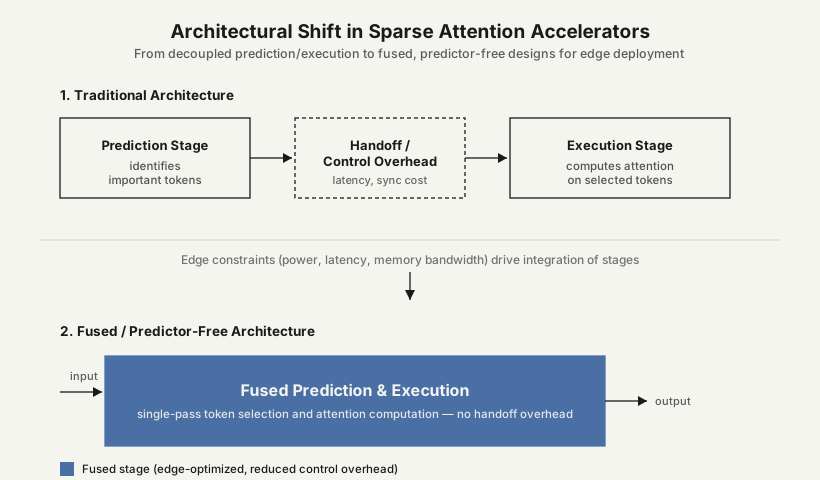
More recent work has focused on removing a subtler source of overhead: the separation between deciding what's sparse and executing on that decision. The 2025 STAR accelerator frames the underlying linguistic intuition plainly — "tokens like articles 'a' or 'the' contribute negligibly to semantics and yield near-zero attention values" after softmax suppression, meaning their corresponding key/value vectors can be pruned with minimal effect on the output. STAR's real architectural contribution is a cross-stage tiling strategy that unifies the scheduling of prediction (which tokens matter) and execution (computing only on the selected tokens) — two stages earlier dynamic-sparsity accelerators generally treated as separate pipeline phases, each carrying its own overhead.
A 2026 accelerator, PADE, takes this idea to its logical conclusion by eliminating the separate predictor stage entirely, fusing prediction and execution directly. That matters disproportionately at the edge: datacenter accelerators can afford to run a lightweight predictor as a preliminary pass because power and silicon area are relatively abundant. Edge power budgets can't tolerate that extra stage's control overhead — not without eroding much of the benefit sparsity was supposed to deliver in the first place.
Reconfigurable fabric is also part of this picture. FAMOUS, an FPGA-based accelerator built for Xilinx UltraScale+ devices, demonstrates that flexible, runtime-programmable attention hardware can approach ASIC-class throughput — reaching a measured 328 GOPS — while remaining reconfigurable across different transformer topologies without new silicon synthesis. For edge devices that need to support multiple model variants without fabricating dedicated chips for each, that programmability isn't a minor convenience. It's often the deciding factor in whether an accelerator is deployable at all.
Where the Rubber Meets the Edge Silicon
The papers above are largely architecture-first, benchmarked against GPU or CPU baselines rather than mobile power envelopes. A distinct and increasingly important cluster of work asks the question directly: what does sparse attention actually look like when the target isn't a research testbed, but a genuinely constrained edge device?
H2EAL is the most directly on-topic answer. It combines hybrid (static plus dynamic) sparse attention with a hybrid-bonding architecture — an advanced 3D packaging approach that physically co-locates memory and compute rather than treating them as separate chips connected by a bus. The authors describe "memory-compute co-placement and adaptive heterogeneous mapping" as the mechanism for resolving both KV-cache management and workload imbalance at the edge, and the reported results are substantial: 5.20–48.21× speedup and 6.22–73.48× energy efficiency improvement, with negligible accuracy degradation, versus baseline edge inference. That wide range in both figures reflects that the gains scale with context length and workload characteristics — a smaller win at short context, a dramatically larger one as sequences grow, which is exactly the regime where quadratic attention cost bites hardest.
TENET approaches the problem from the extreme-quantization side, targeting ternary (BitNet-style) LLMs on edge hardware. Its key architectural contribution is a "Linear-Projection-aware Sparse Attention dataflow that exploits inter-token sparsity in the attention mechanism to enable data reuse and computation fusion between QKV linear projections and attention," eliminating redundant memory accesses during prefill. Validated on both FPGA and ASIC platforms, the authors report that their resulting sparse BitNet configuration "achieves comparable accuracy compared to the vanilla full precision Llama LLM with the same model size" — a claim worth pausing on, since it suggests the accuracy cost of aggressive sparsity plus extreme quantization can, under the right dataflow design, land close to negligible rather than merely acceptable.
IntAttention attacks a different axis of the same problem: not token-count sparsity, but datatype overhead. Rather than reducing how many tokens are attended to, it reduces the cost of each attention computation by integrating "sparsity-aware clipping, a 32-entry lookup table approximation, and direct integer normalization, thereby eliminating datatype conversion overhead along the attention path." Critically, this was validated on plain Armv8 CPUs — no dedicated NPU silicon required — reporting up to 3.7× speedup and 61% energy reduction over FP16 baselines, and up to 2.0× speedup over conventional INT8 attention pipelines. For the enormous installed base of edge devices that lack a dedicated AI accelerator, this may be the most immediately deployable result in the entire research landscape.
AccLLM rounds out this cluster by combining several of these ideas at once: structured pruning, shape-aware ("Λ-shaped") attention, and an aggressive mixed-precision quantization scheme the authors describe as W2A8KV4 — 2-bit weights, 8-bit activations, 4-bit KV cache — explicitly "reducing memory and bandwidth requirements while facilitating LLMs' long-sequence generation." It's a useful illustration of where the field is heading: not a single silver-bullet technique, but a stack of complementary reductions, each attacking a different resource — compute, memory, bandwidth — simultaneously.
Finally, the practical question of where these sparse attention patterns actually run matters quite a bit. A 2025 ASPLOS paper on fast on-device LLM inference with commercial mobile NPUs addresses a mismatch that's easy to overlook in purely academic accelerator research: commercial NPUs are generally optimized for dense, regular compute patterns, while attention sparsity is dynamic and irregular by nature — and prefill/decode phases place fundamentally different demands on the same hardware. Bridging that gap, mapping research-grade sparse attention onto silicon that wasn't designed with sparsity as a first-class citizen, is likely to remain an open and commercially consequential problem for some time yet.
Adjacent but Essential: Memory-Centric Approaches
Not every relevant innovation lives inside an "accelerator" in the strict sense. Two memory-hierarchy ideas deserve mention because they attack the same bottleneck — the linearly growing KV cache — from outside the compute pipeline entirely.
InstInfer offloads KV-cache-heavy attention computation to Computational Storage Drives, motivated by the observation that increasing context length and batch size "escalate the memory requirement of the key-value (KV) cache, which imposes a huge burden on the GPU VRAM, especially for resource-constraint scenarios (e.g., edge computing and personal devices)." This is a datacenter-oriented paper, but its underlying motivation — that KV-cache growth eventually outpaces the memory budget available for compute — applies with even more force to edge devices.
Separately, compute-in-memory (CIM) architectures represent an increasingly active adjacent silicon research direction. Referenced designs include a 28nm full-digital, bitline-transpose CIM-based sparse transformer accelerator reporting 15.59 μJ per token, with pipeline and parallel reconfigurable execution modes. The significance here is structural: fusing sparsity with in-memory compute — rather than treating them as separate optimizations bolted onto a conventional von Neumann pipeline — is an emerging silicon research direction aimed specifically at ultra-low-energy edge inference.
Where the Patent Landscape Stands (and Where It Doesn't)
A note on methodology before wading into patents: direct verification against Google Patents and the USPTO Full-Text Database wasn't achievable during this research cycle, due to a tooling limitation. What follows is drawn from a single secondary industry-analysis source, and should be read as directional rather than definitive.
That source references filed patent activity attributed to South Korean and Chinese institutions — including a described method that performs full attention for an initial number of steps, detects diagonal and vertical structural regularities in the resulting scores via convolution, and encodes those regularities into a reusable sparse mask, explicitly framed as suited to deployment scenarios "where calibration data is unavailable." Separately, activity attributed to a Chinese national laboratory reportedly covers an "anchor compression" method for reducing effective sequence length presented to the attention mechanism, rather than masking the full attention matrix. Neither of these can be confirmed against a primary patent record in this research pass, and specific patent numbers, filing dates, and claim scope remain unverified.
What can be said with more confidence is the pattern this activity suggests: patent-adjacent innovation appears concentrated around mask pre-computation and reuse, token/anchor compression, and combined attention-plus-feedforward sparsification — themes that track closely with the academic literature surveyed above. That's consistent with a globally distributed and actively contested research area. But readers should treat any specific patent claim in this space as provisional, pending direct primary-source confirmation.
Speculation: Where This Architecture Class Is Headed
The following section extends beyond confirmed results into forward-looking inference, grounded explicitly in the trajectories the dossier's sources establish. These are reasoned extrapolations, not confirmed roadmaps.
Speculation: The convergence already visible across TENET (ternary/LUT-centric design), IntAttention (integer-only pipelines), and CIM/memristor accelerators suggests future edge NPUs won't deploy sparsity in isolation — they'll stack it with sub-8-bit quantization and near-memory compute as a single co-designed system. A natural extension of SpAtten's existing adaptive-bitwidth concept — where quantization precision is already chosen dynamically based on the attention distribution — would be accelerators that jointly co-select bitwidth and sparsity pattern per attention head at runtime, rather than treating these as two independently tuned knobs.
Speculation: Predictor-free, fused-stage designs in the style of PADE are likely to become the dominant pattern specifically for edge silicon, for a fairly straightforward reason: datacenter accelerators can amortize the cost of a separate lightweight prediction stage across a large batch and a generous power budget, but edge power budgets can't absorb that control overhead without eroding much of sparsity's benefit. This has direct implications for how future ASIC tape-outs targeting smartphone and wearable NPUs are likely to be structured.
Speculation: Advanced 3D packaging — specifically the hybrid-bonding approach demonstrated in H2EAL — is a strong candidate to migrate from research accelerators into commercial edge system-on-chip designs. It directly addresses the memory-compute co-placement problem that logic scaling alone can't solve for KV-cache-bound long-context workloads, mirroring a pattern already visible in HBM-adjacent datacenter accelerators. Call it a "trickle-down" hardware roadmap — packaging innovations proven at datacenter scale reappearing, in adapted form, in edge silicon.
Speculation: Structured N:M and X:M pruning may well become first-class citizens in future edge NPU instruction sets, much the way structured sparsity became a first-class Tensor Core feature in datacenter GPU architectures. DynaX's generalization from fixed-N to variable-X pruning suggests future NPU instruction set architectures may need to support variable-arity structured sparsity, rather than the fixed patterns common in current commercial hardware — a meaningful design decision for any silicon team planning multi-year NPU roadmaps today.
One further extrapolation deserves an explicit caveat rather than confident framing: the idea that in-storage or near-memory attention offload, in the style of InstInfer, could migrate to consumer edge devices with NVMe or UFS storage — potentially enabling contexts of several hundred thousand tokens on devices without server-class memory. It's a logical fit on paper. But it remains unproven at genuine edge power and latency budgets, and should be understood as a research extrapolation rather than a confirmed trajectory.
Closing: The Shape of the Next Generation
What distinguishes this research landscape from a purely academic exercise is how directly it maps onto commercial pressure. Long-context capability is increasingly treated as table stakes for capable on-device assistants, agents, and multimodal systems — and every one of those use cases runs directly into the quadratic wall that the papers surveyed here are built to dismantle. The clearest throughline across NSA, DynaX, SpARC, H2EAL, TENET, and IntAttention is that the winning designs are the ones that stop treating sparsity as a software-layer optimization applied after the hardware is fixed, and instead treat the sparsity pattern, the memory hierarchy, and the quantization scheme as one single co-designed system.
This piece has focused on the algorithm-hardware boundary — how sparsity patterns get chosen and how silicon executes them. Two natural extensions follow directly from what's been surveyed here. The commercial mobile NPU landscape — how Qualcomm's Hexagon, Apple's ANE, and MediaTek's APU each handle, or currently fail to handle, dynamic attention sparsity — deserves a dedicated treatment of its own, building directly on the on-device NPU research discussed above. Compute-in-memory architectures for transformer inference more broadly are similarly a much larger space than the single memristor reference touched on here, and warrant a focused deep-dive in their own right. And the hybrid-bonding packaging approach underlying H2EAL points toward a broader story about advanced packaging and chiplets in edge AI silicon — a narrative distinct from the datacenter-packaging coverage that dominates most current reporting.
For now, the state of the art is clear on one point: at the edge, attention doesn't get cheaper by making it smaller. It gets cheaper by making the hardware and the algorithm agree, in advance, on what's worth computing at all.
Stay in the loop. Project Isocline publishes deep-dive technical analysis on AI infrastructure, energy systems, and the engineering decisions shaping the next decade of compute. No noise. No fluff. Subscribe to the newsletter → You can unsubscribe at any time.