Two-Phase Cold Plates: Boiling at the Chip Without Immersing the Server
At a Glance
- The problem isn't boiling — it's what happens after. Two-phase cold plates use a dielectric fluid that boils on contact with a hot chip surface, absorbing heat as latent heat of vaporization rather than sensible heat. The physics is identical to immersion cooling. The engineering problem isn't.
- Vapor has nowhere to go. In an open immersion bath, vapor bubbles rise freely to the surface. In a sealed cold plate's microchannels, vapor gets generated inside a confined geometry it shares with incoming liquid — and it can choke the channel, degrading heat transfer and destabilizing flow.
- The current architectural trend is separation, not better boiling. Recent designs — most concretely, a dual-outlet hollow-micropillar cold plate described in a 2024/2025 working paper — give vapor its own dedicated exit pathway instead of forcing it to share an outlet with incoming liquid.
- A parallel patent shows where the fluid strategy is heading. US Patent 12,238,895 describes a cold plate housing both a conventional coolant loop and a two-phase dielectric loop in one body, and explicitly designs its dielectric fluid to serve both cold-plate and immersion-tray applications — a signal that cooling architecture and fluid chemistry are decoupling as separate procurement decisions.
- Regulatory risk sits underneath all of this. PFAS-class dielectric fluids face an active restriction proposal from the European Chemicals Agency, and the two-phase cold plate literature reviewed here doesn't name a specific fluid chemistry — a gap that matters more than any microchannel geometry.
This piece follows from Liquid Cooling Architectures for Exascale Data Centers, which framed the field as a choice between single-phase direct-to-chip cooling and immersion. Two-phase cold plates are what that framing leaves out: a third path that borrows immersion's thermodynamic advantage while keeping the server in its chassis.
Why Phase Change Beats Temperature Rise
Every cooling method in a data center ultimately does one of two things to a fluid: it either raises the fluid's temperature, or it changes the fluid's phase.
Single-phase direct-to-chip liquid cooling does the first. A coolant — water, a water-glycol mix, or a single-phase dielectric — flows across a cold plate bonded to the chip lid, picks up heat as sensible heat (its temperature rises), and carries that heat away to be rejected elsewhere. The amount of heat you can remove this way is bounded by how much you can raise the fluid's temperature and how fast you can pump it.
Two-phase cooling does the second. A low-boiling-point dielectric fluid — an electrically non-conductive liquid safe to bring into direct contact with electronics — is deliberately allowed to boil when it touches the hot surface. That phase change from liquid to vapor absorbs a large quantity of energy as latent heat of vaporization, with comparatively little temperature rise. Full immersion cooling exploits exactly this mechanism: servers are submerged in an open bath of dielectric fluid, which boils directly off the hottest components and releases vapor into open headspace above the bath, where it condenses and drips back down.
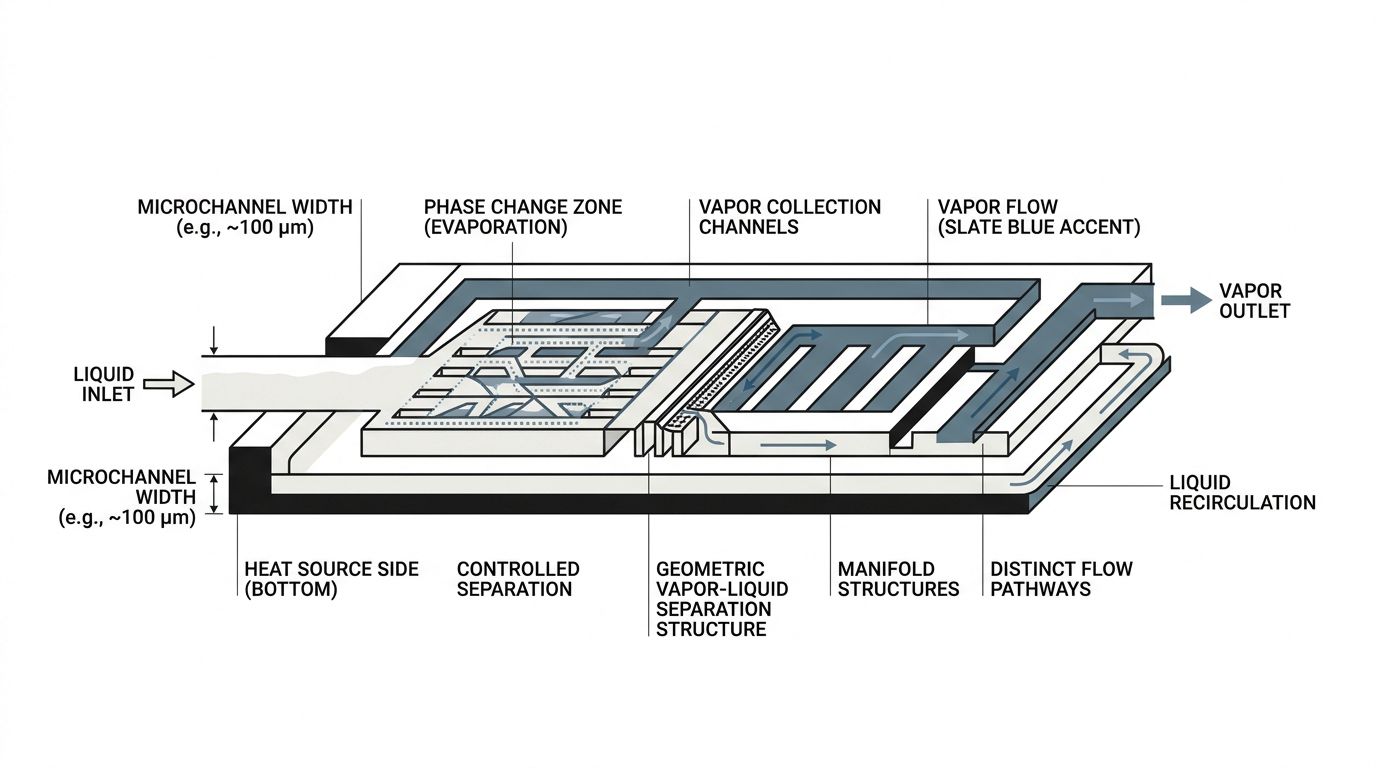
A two-phase cold plate is an attempt to get that same latent-heat advantage without submerging the server. The dielectric fluid is pumped through microchannels bonded to the chip, boiling locally at the die or lid surface, then routed out of the cold plate to be condensed and recirculated. Same mechanism. Different geometry. And that difference in geometry is where all the difficulty lives.
The Geometry Problem: Liquid In, Vapor Out, One Channel
In an open immersion bath, a vapor bubble generated at a hot chip surface has an easy exit: it rises through the dielectric fluid and escapes at the open top of the tank. Nothing downstream constrains it. The liquid above the bubble simply gets out of the way.
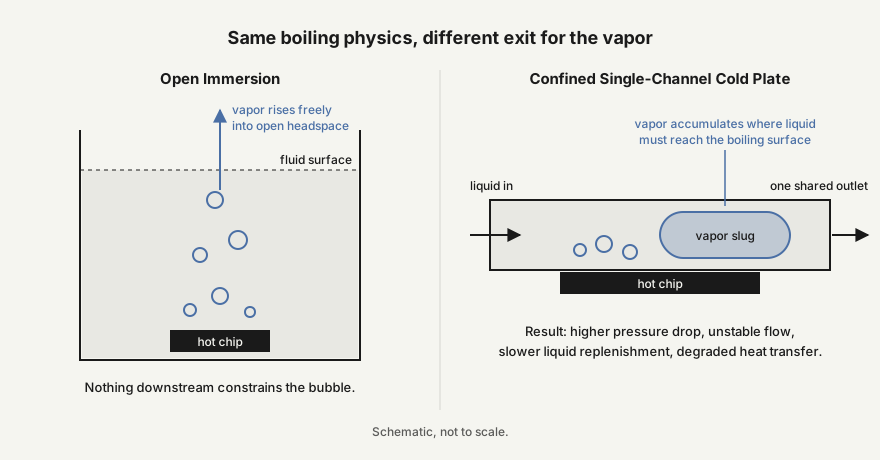
A cold plate's microchannels offer no such freedom. Vapor gets generated inside a narrow, enclosed channel that the incoming liquid must also use to reach the boiling surface. The retrieved research on this topic is specific about what goes wrong when the two flows compete for the same space:
"Pumped two-phase cooling can provide high heat-flux capability for advanced electronic packages, but vapor accumulation in confined cold plates can increase pressure drop, induce flow instabilities, impede liquid replenishment, and degrade heat transfer."
This is the single fact that separates two-phase cold plates from both of their thermal-management neighbors. Single-phase cold plates never generate vapor, so the problem doesn't exist. Immersion cooling generates vapor in an open geometry, so it escapes without obstruction. A two-phase cold plate is the only architecture in this comparison that generates vapor and confines it — and that confinement is what current flow-stabilization engineering in this space is trying to work around.
"Vapor accumulation" understates the mechanics of the failure mode. As vapor bubbles form and grow inside a microchannel, they occupy volume that liquid coolant needs in order to reach the boiling surface downstream. If vapor generation outpaces vapor removal, the channel effectively chokes: pressure drop rises, flow becomes unstable, fresh liquid can't replenish the boiling surface fast enough, and the very heat-transfer advantage the phase change was supposed to deliver starts to degrade. In the worst case, the result looks less like efficient boiling and more like a fluttering, unstable flow regime that undermines the reliability a data center operator needs.
Solving It by Separating the Two Jobs, Not by Improving the Boil
The most concrete architectural response to this problem in the current literature stops treating "get liquid in" and "get vapor out" as one transport problem. It treats them as two.
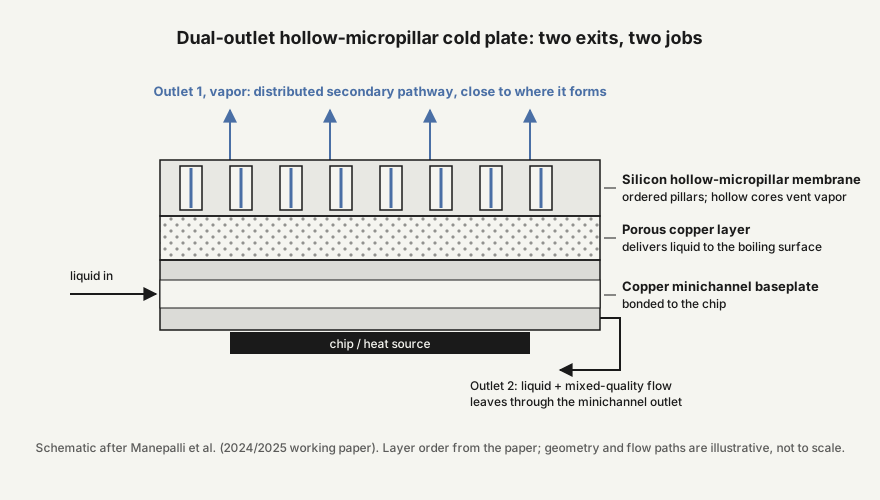
A 2024/2025 working paper by Manepalli, Guye, Kim, Pundla, Smith, D. Agonafer, Graham, and D. Agonafer describes a direct-to-chip two-phase cold plate built from three stacked functional layers: a copper minichannel baseplate, a porous copper liquid-delivery layer, and an ordered silicon hollow-micropillar membrane arranged in a dual-outlet configuration. The paper describes the departure from conventional design explicitly:
"The architecture integrates a copper minichannel baseplate, porous copper liquid-delivery layer, and ordered silicon hollow micropillar membrane within a dual-outlet configuration... unlike conventional confined flow-boiling cold plates, the architecture provides a distributed secondary pathway for vapor removal while allowing liquid and mixed-quality flow to discharge through the minichannel outlet."
The mechanical logic is straightforward once you see it laid out. A conventional two-phase cold plate has one outlet, and everything — liquid that never boiled, vapor that did, and mixed-quality slug flow in between — has to leave through that single opening. This design instead gives vapor a distributed secondary pathway through the micropillar membrane sitting above the porous liquid-delivery layer, so vapor can escape locally, close to where it's generated, rather than traveling the length of the channel merged with liquid flow headed the same direction.
That's a meaningfully different optimization target from earlier single-outlet designs that focused on maximizing the raw heat transfer coefficient at the boiling surface — essentially, how much heat can we absorb per unit area. This design instead optimizes the transport network downstream of the boil. It treats liquid delivery and vapor egress as separately solvable engineering problems rather than accepting whatever transport behavior falls out of a single shared channel.
The retrieved abstract doesn't specify the dielectric fluid chemistry used in the prototype, its boiling point, or its regulatory classification. It also doesn't include quantitative critical heat flux or heat-transfer-coefficient figures — the numbers a thermal engineer would ultimately want before treating this as a qualified design rather than an architectural proof of concept. Critical heat flux (CHF) is the point at which boiling becomes so vigorous that vapor forms a stable insulating film on the heated surface, at which point heat transfer collapses and surface temperature spikes — the practical ceiling any two-phase design has to respect. Without CHF numbers for this specific architecture, it's fair to describe the dual-outlet design as a structurally sound approach to the vapor-choking problem, but not yet as a benchmarked performance claim.
A Patent That Hedges Its Bets: The Dual-Loop Cold Plate
Where the academic work optimizes the internal geometry of a single boiling surface, a separate line of engineering — visible in an issued US patent — takes a different approach to risk: build one cold plate that can run two cooling strategies at once.
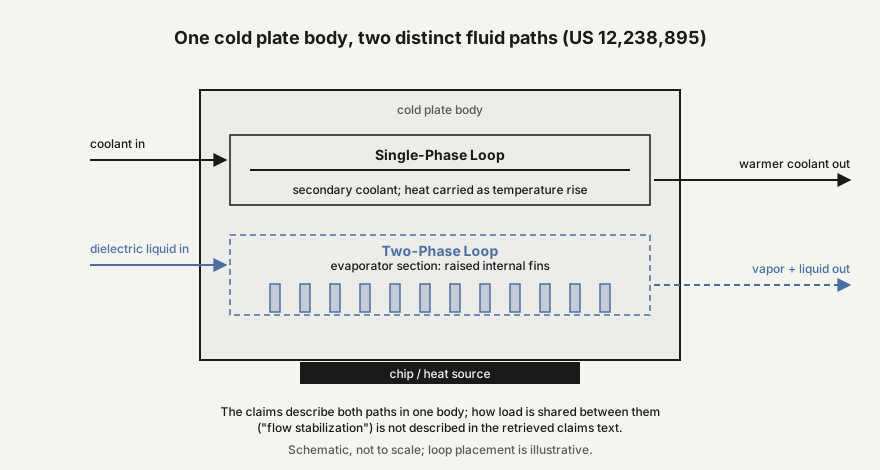
US Patent 12,238,895, "Intelligent low pressure two-phase cold plate with flow stabilization for datacenter cooling systems," describes a cold plate housing two physically distinct fluid paths in a single body: a conventional secondary-coolant loop and a two-phase dielectric loop.
"A dual-cooling cold plate has distinct paths (each path also referred to as microchannels) for secondary coolant of a secondary cooling loop and for two-phase fluid of a two-phase fluid cooling loop... secondary coolant or two-phase fluid may not be dielectric in property in at least one embodiment."
The two-phase side of the plate is structurally distinguished from the single-phase side by its internal geometry:
"Some microchannels are paths provided by fins or other such aspects that are raised internally and perpendicularly to a base of a cold plate section so that there are gaps therebetween for fluid or coolant flow... some microchannels for two-phase fluid represent an evaporation (or evaporator) section for a cold plate."
Read alongside the vapor-egress problem above, this dual-loop design looks less like a novel solution to vapor choking and more like a hedge against it: if the two-phase evaporator section runs into flow instability under a given workload, the conventional single-phase loop is still present in the same physical unit to share or absorb the thermal load. The patent's title references "flow stabilization," implying some form of active control — sensors, valves, or dynamic load-shifting between the two loops — but the retrieved claims text doesn't describe the specific control mechanism. That detail remains an open question rather than a documented feature.
The more strategically interesting claim in this patent has nothing to do with the cold plate's internal plumbing and everything to do with what fluid it's designed to hold.
The Convergence Signal: One Fluid, Two Form Factors
Buried in US 12,238,895's claims is a statement that connects this entire topic back to the exascale liquid-cooling landscape more broadly:
"In at least one embodiment, in a use case of an immersive-cooled server, two-phase fluid that may be a dielectric engineered fluid may be adapted for both, a cold plate application and an immersive-cooled server tray application."
This reframes the relationship between two-phase cold plates and immersion cooling. The prior article on exascale liquid-cooling architectures treated single-phase direct-to-chip cooling and immersion cooling as two competing bets a data center operator has to choose between — different form factors, different infrastructure, different qualification burdens. What this patent describes is a scenario where the fluid is the shared asset and the form factor is a secondary, almost interchangeable decision layered on top of it. The same dielectric chemistry that boils inside a sealed cold plate's microchannels could, in principle, be the same fluid a server tray sits open in.
Speculation: If that pattern holds across the industry, it points toward a practical possibility rather than a documented outcome: rather than qualifying one dielectric fluid for immersion racks and a separate one for two-phase cold-plate racks — with separate supply chains, separate reclamation processes, separate safety and compatibility testing — a facility could in principle standardize on a single fluid chemistry and deploy it across both architectures depending on rack-level thermal requirements. Cold-plate racks and immersion racks would, under this scenario, stop being rival infrastructure investments and start being two mechanical expressions of the same fluid-handling investment. No retrieved source confirms this is happening at deployment scale; the patent establishes the design intent, not the outcome.
The shared asset this patent points toward isn't the cooling method. It's the fluid.
What the Numbers Around This Technology Actually Say
None of the architectural detail above happens in a vacuum. It's being driven by a specific, quantifiable pressure on chip thermal design, and it's landing in an industry already mid-transition toward liquid cooling broadly.
Current high-performance processors run at heat flux levels of 100 to 150 W/cm², with future generations projected to exceed 200 W/cm². That trajectory is the reason single-phase cold plates are running out of headroom in the first place: sensible-heat removal scales with flow rate and temperature delta, both of which have practical ceilings, while latent-heat removal via phase change can absorb substantially more energy per unit of fluid moved. Two-phase cold plates exist because the chip side of this equation is outrunning what temperature-rise cooling alone can handle.
At the rack level, the pressure is showing up as a shift in average power density. Average rack power density was 8.9 kW as of 2022, but a fifth of organizations were already reporting more than 20 kW per rack by 2023, and a significant portion of new deployments are projected to exceed that threshold going forward. This is the density band where air cooling stops being viable and liquid cooling — in some form — becomes close to mandatory.
That shift is already visible in adoption intent: 51% of data center operators are projected to be using or planning to deploy liquid cooling solutions by 2025, according to Uptime Institute survey data. Separately, market-research estimates put the global data center liquid cooling market at $3.6 billion in 2023, projected to reach $13.9 billion by 2030 at a compound annual growth rate of 23.9% — figures that should be read as directional industry sizing from market-research methodology rather than an audited measurement, given they carry an unverified-methodology flag in the underlying data.
None of this by itself validates two-phase cold plates specifically over single-phase liquid cooling or immersion. What it does establish is the environment two-phase cold plates are being engineered into: a rack density curve moving upward fast enough that operators are actively evaluating every liquid-cooling variant, and a chip heat-flux curve that makes latent-heat removal look increasingly attractive regardless of which mechanical form factor delivers it.
Where This Runs Into Friction
The vapor-egress engineering described above solves a mechanical problem. It doesn't touch the risks sitting underneath the whole category of dielectric-fluid cooling, and those risks aren't evenly weighted.
The most severe of them is regulatory. PFAS — per- and polyfluoroalkyl substances — are a class of engineered chemicals valued in dielectric cooling fluids for their thermal stability and non-conductivity, and also the subject of an active restriction proposal from the European Chemicals Agency, filed in March 2023. Neither the academic hollow-micropillar paper nor the dual-loop patent reviewed here names a specific fluid chemistry, boiling point, or PFAS/GWP (Global Warming Potential) classification for the fluids their designs are built around. That gap is arguably the single largest unresolved dependency in the entire two-phase cold plate proposition. A cold plate architecture can solve vapor choking perfectly and still be commercially unviable if the fluid it depends on gets regulated out of the market or forced through an expensive reformulation cycle. This risk is rated high-severity precisely because its resolution — a shift to non-PFAS alternatives — requires fluid reformulation and requalification that no amount of microchannel geometry engineering can substitute for.
Below that sits a set of more familiar deployment frictions. High initial capital expenditure is a medium-severity barrier, driven by budget constraints and the slower return-on-investment timeline of liquid-cooling retrofits relative to air cooling, though phased deployment and efficiency incentives are the typical mitigation path. Operational complexity is also medium-severity: installing and maintaining a system with two distinct fluid loops and boiling-surface microchannels demands specialized skills that many facilities' current staff don't have, and the mitigation — standardized designs and vendor training — is still maturing across the industry. A related medium-severity risk is the lack of industry standardization itself; interoperability between vendors is an open problem, one the Open Compute Project's Advanced Cooling Solutions initiative is explicitly trying to address. And perceived leak risk, while rated low-severity, remains a real factor in operator apprehension and insurance conversations, even though dielectric fluids are non-conductive by design and robust leak detection substantially reduces the practical danger.
Two-phase cold plates don't uniquely face any one of these risks. But the dual-loop patent's premise — one fluid, multiple form factors — means that whatever happens to a given dielectric chemistry's regulatory status will ripple across both the two-phase cold-plate market and the immersion cooling market simultaneously. Fluid convergence cuts both ways: it reduces qualification overhead when things go well, and it concentrates risk when a single fluid chemistry runs into a compliance wall.
Speculation: Where Vapor-Channel Engineering Could Go Next
Speculation: If separating liquid delivery from vapor egress is the right general strategy for confined-channel boiling — and the dual-outlet micropillar design suggests it is — the next logical extension is spatial, not just structural. Large multi-chiplet packages, including stacked memory-and-logic configurations, don't generate heat uniformly across their surface; some regions run measurably hotter than others under real workloads. A micropillar membrane with uniform pore density, as described in the retrieved research, gives every region of the die the same vapor-egress capacity regardless of how much vapor that region actually produces. A membrane engineered with spatially varying pore density — denser vapor pathways positioned over known hot zones — could in principle match vapor-removal capacity to local vapor generation rather than treating the whole die as a uniform boiling surface. No retrieved source describes this specific design; it's offered here as a forward-looking engineering implication of the general trend the dual-outlet architecture represents, not as a documented feature of any existing product or patent.
Speculation: The same logic extends to control, not just geometry. US 12,238,895's "intelligent flow stabilization" language implies some active control loop already exists in at least one design, even though its specific mechanism wasn't available in the retrieved claims text. If per-die thermal telemetry becomes more granular — and chip-level telemetry has been trending in that direction across the industry — a natural next step would be workload-aware control logic that shifts load dynamically between a two-phase loop and a conventional secondary loop in a dual-cooling cold plate, rather than relying on static thermal design alone. This too is a plausible trajectory rather than a documented one.
Where This Leaves the Broader Cooling Landscape
The most useful way to place two-phase cold plates within the wider liquid-cooling picture is not as a fourth competitor to single-phase cooling and immersion cooling, but as connective tissue between them. They inherit the latent-heat physics of immersion cooling and the chassis-preserving form factor of direct-to-chip single-phase cooling, and the current engineering frontier — vapor-channel separation, illustrated concretely by the dual-outlet hollow-micropillar design — is about making that hybrid actually reliable at scale rather than a laboratory curiosity.
A cluster of related patent families on active flow control for two-phase cooling systems surfaced during research for this piece, though their claims content has not been reviewed and verified here. Taken only as a pattern of filing activity — not as a confirmed timeline of technical progress — their existence is consistent with the idea that flow stabilization, rather than raw boiling performance, has been the field's persistent unsolved problem. The current generation of dual-outlet and dual-loop architectures reads as an iteration on that effort rather than a final answer, though establishing exactly how it fits into that longer history would require verifying those filings directly.
What comes after a cold plate successfully gets vapor out of its microchannels is a question this dossier doesn't answer but clearly points toward: that vapor still has to be condensed back into liquid and returned to the loop somewhere upstream. The natural next subject is the condenser and coolant distribution unit (CDU) infrastructure that two-phase loops depend on — the plumbing that turns a solved cold-plate problem into a complete, closed-loop cooling system. That's the logical next stop in this line of research, and it follows directly from the vapor-management problem examined here.
Stay in the loop. Project Isocline publishes deep-dive technical analysis on AI infrastructure, energy systems, and the engineering decisions shaping the next decade of compute. No noise. No fluff.
You can unsubscribe at any time.