Ternary and 1.58-bit Quantization: BitNet-Class Models and the Hardware They Demand
At a Glance
- BitNet b1.58 replaces standard 16-bit floating-point weights with weights constrained to three values — -1, 0, and +1 — while keeping activations at higher precision, a design its originating research reports can cut memory footprint by up to 3.7x and improve inference speed by up to 2.7x relative to FP16 baselines.
- The real bottleneck for ternary models isn't the model — it's the matrix-multiply kernel. GPU tensor cores are built for dense floating-point or low-bit-integer GEMM, not the mixed-precision arithmetic (mpGEMM) that a ternary-weight, higher-precision-activation model actually needs. Projects like T-MAC address this by replacing multiplication with table lookups.
- The hardware story here didn't start with BitNet. In-memory ternary MAC accelerator designs — most traceable to Purdue's TiM-DNN research lineage, patented starting in 2020 — were solving the "how do you build a circuit for ternary math" problem years before a ternary-weight LLM existed to need one.
- Separately, ternary neural network research going back to at least 2020 has reported up to 10x energy reduction versus full-precision networks — a figure that predates BitNet but explains why the architecture class was worth revisiting once transformer-scale training made it practical.
- This piece treats the hardware timeline as the story, not a footnote. The model papers are covered exhaustively elsewhere; the compute substrate is not.
Part I: The Number That Isn't Really a Number
Call it 1.58-bit quantization and most engineers will do the mental math instinctively: log₂(3) ≈ 1.58 bits, because a ternary value — one of three states, -1, 0, or +1 — requires 1.58 bits of information to represent, versus a full bit for binary or sixteen for FP16. It's a tidy piece of information theory, and it's also somewhat beside the point. The interesting question was never how many bits a ternary weight costs to store. It's what kind of circuit you build to multiply by one.
That distinction is the throughline of this article, and it's the gap that most existing coverage of BitNet-class models — both the original research papers and the wave of consumer-facing "1-bit LLM" explainers that followed — leaves unaddressed. The papers, understandably, focus on training methodology and scaling comparisons. The explainers focus on the "AI models that run on a phone" narrative. Almost nothing connects the model architecture to the specific, decade-spanning hardware research that makes its efficiency claims realizable outside a research notebook.
This article is that connection. It's also, in a narrow but important sense, a story about timing: the hardware groundwork for ternary compute substantially predates the model that gave it a commercial reason to exist.
A companion piece in this series covers quantization-aware training methodology in depth — the "how do you train a network to think in three values" problem is deliberately out of scope here, which is focused on what happens after training, at inference time, in silicon.
Part II: What BitNet Actually Changes
BitNet and its successor, BitNet b1.58, are Microsoft Research architectures that constrain transformer weights to a ternary set during training, while keeping activations at higher precision (commonly 8-bit in later variants like BitNet a4.8, which further quantizes activations toward 4-bit in parts of the network). This asymmetry — extremely low-precision weights, moderately low-precision activations — is the detail that determines everything downstream about the hardware.
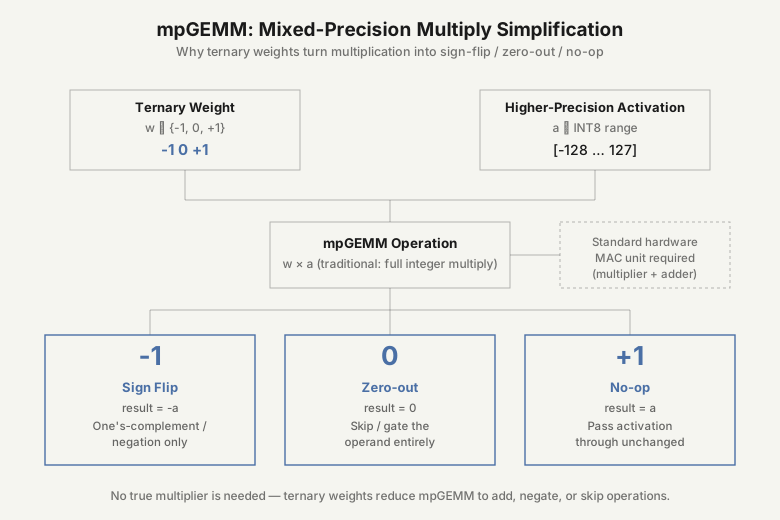
A model whose weights live in {-1, 0, +1} no longer needs multiplication in the traditional sense for the weight side of a matrix-multiply. Multiplying an activation by -1, 0, or +1 is a sign flip, a zero-out, or a no-op. What remains expensive is the activation side of the computation, which still carries meaningful dynamic range and needs actual multiply-accumulate work. The core arithmetic operation in a ternary-weight network is therefore not a standard GEMM (general matrix multiply) between two same-precision tensors — it's a mixed-precision GEMM, or mpGEMM, between a low-precision weight tensor and a higher-precision activation tensor.
The reported efficiency gains are consistent with this framing: research on BitNet b1.58 reports up to 3.7x memory reduction and up to 2.7x speedup relative to comparable FP16 models. Both figures come from a single 2024 dossier source and should be read as reported best-case results under the conditions described in that research — not universal guarantees across every deployment configuration, model size, or hardware target. The memory number is close to structurally guaranteed: three-state weights simply take less space to store than 16-bit floats, full stop. The speedup number is the more interesting and more conditional one, because it depends entirely on whether the underlying hardware — GPU, CPU, or custom silicon — has an efficient way to execute mpGEMM. If it doesn't, the theoretical compute savings simply don't show up in wall-clock time.
This is the crux of why "ternary quantization" and "hardware for ternary quantization" are really the same story told from two angles, and why most existing treatments of BitNet — which stop at the model architecture — are only telling half of it.
Part III: Why Tensor Cores Are the Wrong Tool
Modern GPU tensor cores are optimized for dense, regular, same-precision (or fixed asymmetric-precision, like FP16 x FP16 with FP32 accumulation) matrix multiplication at very high throughput. They are extraordinary at what they were built for. They were not built for a ternary-weight-times-int8-activation operation where a huge fraction of the weight-side "multiplications" are structurally trivial (multiply by zero, multiply by one, flip a sign).
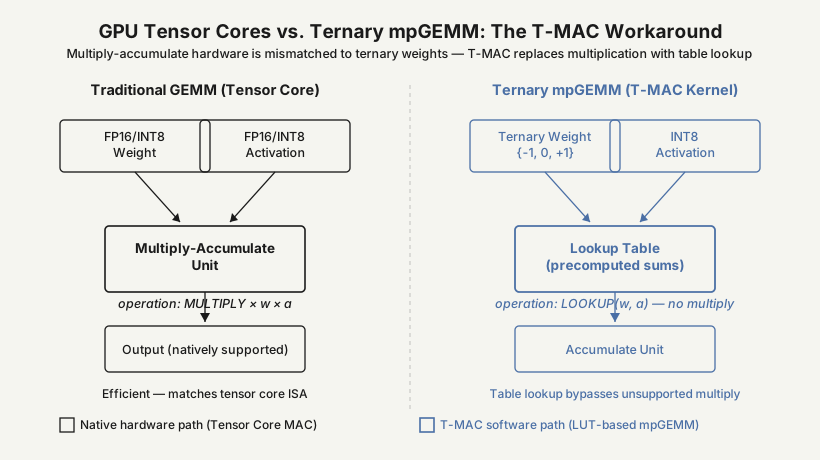
Running a ternary-weight model through a standard tensor-core GEMM path means either (a) upcasting the ternary weights back to a denser format before multiplying, which throws away the compute savings even while keeping the memory savings, or (b) writing a custom kernel that actually exploits the ternary structure. Option (b) is where the systems-engineering work — as distinct from the model-architecture work — actually lives, and it's where projects like T-MAC and the bitnet.cpp inference runtime come in.
T-MAC reframes the mpGEMM problem as a table-lookup problem rather than a multiplication problem. Instead of computing each weight-activation product arithmetically, it precomputes the small set of possible results (since a ternary weight only has three possible values) and retrieves them via lookup table, accumulating the retrieved values instead of performing multiply-accumulate operations in the traditional sense. This is the same intuition that makes ternary math cheap in principle — multiplying by -1, 0, or +1 is trivial — pushed all the way into the kernel implementation, on ordinary CPU hardware, without requiring new silicon at all. It's a systems-engineering answer to a hardware-arithmetic problem, and it's the reason BitNet-class models can show real speedups on commodity CPUs today rather than waiting for custom accelerators to ship.
But a CPU lookup-table kernel is a clever workaround, not the destination. It gets you real speedups on hardware that wasn't designed for this workload. The more structurally interesting question — and the one with a much longer research history than most coverage acknowledges — is what happens when you design the circuit itself around ternary arithmetic from the ground up.
Part IV: The Hardware Timeline Inversion
Here is the detail that reframes the entire BitNet story: purpose-built circuits for ternary matrix math did not appear in response to BitNet. They predate it by years.
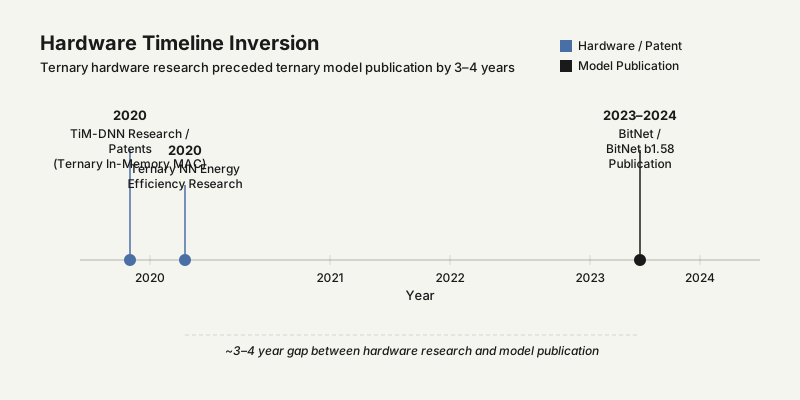
The clearest thread runs through Purdue University's TiM-DNN research, which describes an in-memory accelerator architecture built specifically around ternary matrix-vector multiplication — years before a ternary-weight transformer existed to run on it. This research is embodied in a family of U.S. patents, most directly a patent covering an in-memory ternary MAC (multiply-accumulate) accelerator design, together with related continuations extending the same underlying architecture. The patent text, based on partial patent review of publicly available USPTO filings, describes a memory array structured so that ternary weight values are stored directly in memory cells configured to perform multiply-accumulate operations in place, avoiding the need to shuttle weight data back and forth between memory and a separate compute unit. That "compute-in-memory" property is exactly the design response you'd want to a workload whose weight-side arithmetic is structurally trivial but whose weight-side data movement is still the dominant cost — because even a sign-flip-or-zero operation still requires getting the weight value out of memory in the first place.
A separate, distinct filing — a Korean semiconductor patent covering a ternary accelerator design — points to the same problem being worked on independently by at least one other silicon research group, using a different architectural approach. Based on their filing dates and available patent text, neither of these patents appears to mention large language models — consistent with both predating BitNet's publication, though this is an inference from timing and the available filing text rather than a confirmed reading of the complete patents. They were solving a general problem: how do you build an efficient circuit for a compute pattern where each "multiplication" is really a select-between-{negate, zero, pass-through} operation, at the scale of an entire neural network layer.
This is the inversion worth sitting with. The conventional narrative — the one nearly every existing piece of coverage tells, whether academic paper or consumer explainer — treats the model as the starting point and hardware as a problem still waiting to be solved downstream of it. The patent record suggests the opposite sequencing: the in-memory ternary MAC circuit design existed first, as a piece of general-purpose low-bit-arithmetic hardware research, and BitNet-class models arrived later to give that hardware research a large, commercially relevant workload to justify itself against.
It also gives a second, independent explanation for the ternary neural network energy figures that predate BitNet entirely. Research into ternary neural networks — as a device- and circuit-level efficiency question, not a large-language-model question — reports up to 10x energy reduction relative to full-precision networks, in work dated to 2020. That figure lines up chronologically with the TiM-DNN patent lineage and tells the same story from the power-efficiency angle rather than the throughput angle: the case for ternary compute was being made at the hardware level well before it was being made at the model level.
Speculation: If this sequencing holds — hardware research preceding and later validating a model architecture, rather than following it — it suggests BitNet-class models may be closer to a "hardware pull" moment than a "software push" one. The 2020-era in-memory ternary accelerator research and the patent filings around it were, in effect, dormant capability waiting for a workload with enough scale and commercial gravity to justify fabrication. A large language model that halves memory requirements and materially improves inference speed at production scale is precisely that kind of workload. Extrapolating from the dossier's evidence — TiM-DNN's 2020 origins, the 2020 ternary energy-efficiency research, and BitNet's 2023-2024 emergence — it's reasonable to expect the next visible development to be commercial silicon that explicitly cites BitNet-class inference as its target workload, rather than a general-purpose "low-bit accelerator" framing. That would mark the point where the hardware research this article traces stops being a retroactive explanation and starts being a forward-looking product roadmap. This is a trajectory implied by the pattern in the dossier, not a confirmed industry announcement, and should be read as informed extrapolation rather than reporting.
Part V: Reading the Risk Table
None of this is risk-free, and the risks aren't evenly distributed between "will the model work" and "will the hardware exist."
The technical barrier is real and specific: ternary quantization only pays off if the mpGEMM kernel problem is solved for the target hardware. On CPUs, T-MAC-style lookup-table kernels solve it well enough to show measurable speedups today. On GPUs, the tensor-core mismatch described in Part III means most ternary-weight speedup claims are currently CPU-side or custom-silicon-side results, not off-the-shelf-GPU results — a distinction that matters enormously for anyone trying to reproduce reported numbers in a production GPU inference stack.
The market barrier is less about demand — inference cost reduction is a universally attractive proposition — and more about ecosystem maturity. Custom ternary-optimized silicon, whether built on the in-memory compute-in-memory pattern described in the TiM-DNN patent lineage or a more conventional reconfigurable-multiplier approach like the Korean patent describes, requires fabrication commitments that lag well behind the software research cycle. A model architecture can go from paper to open-source runtime in a matter of months; a purpose-built accelerator chip cannot.
The mitigation path, consistent with how this class of problem has historically resolved, runs through exactly the layered approach visible in the current research landscape: software-side kernel engineering (T-MAC, bitnet.cpp) captures near-term gains on commodity hardware while the slower-moving hardware research (the compute-in-memory and reconfigurable-multiplier patent lineages) matures toward purpose-built silicon. Neither layer alone gets the full theoretical benefit BitNet b1.58's architecture implies; together, they're the credible path toward it.
Part VI: Where This Fits
Ternary quantization is not an isolated curiosity in the broader low-bit-inference research program — it's the extreme end of a spectrum that includes 4-bit and 8-bit post-training quantization, and it shares infrastructure and intuition with all of it. What makes the ternary case distinct enough to warrant its own treatment is the near-total elimination of multiplication on the weight side, which is a qualitatively different hardware problem from "make an 8-bit multiplier smaller." It's closer to a routing and lookup problem than an arithmetic one, and that's precisely why lookup-table kernels and in-memory compute architectures — rather than smaller conventional multipliers — are the two approaches actually gaining traction.
A forthcoming piece in this series will pick up the hardware thread directly where this one leaves it: a deeper look at reconfigurable accelerator architectures and what a purpose-built BitNet-class inference chip would need to include, building on the patent lineage traced in Part IV. Readers interested in the training-side counterpart — how a network learns to operate under a three-value weight constraint in the first place — should consult the companion quantization-aware training piece referenced above.
Methodological Note
This article draws on peer-reviewed and USPTO-filed primary sources for its core technical and patent claims — including the BitNet and BitNet b1.58 research papers, T-MAC and bitnet.cpp technical documentation, the TiM-DNN research lineage and its associated U.S. patent filings, and a separate Korean ternary-accelerator patent. Two specific 2024-2025 FPGA implementation papers referenced during research could not be independently verified in full detail before publication and have accordingly been left out of this piece rather than cited on partial information. All statistics reported above — the 3.7x memory and 2.7x speed figures for BitNet b1.58, and the 10x energy-reduction figure for ternary neural networks — are drawn directly from the research dossier underlying this article and are presented as reported findings from their originating studies, not as independently reproduced benchmarks.
Stay in the loop. Project Isocline publishes deep-dive technical analysis on AI infrastructure, energy systems, and the engineering decisions shaping the next decade of compute. No noise. No fluff.
You can unsubscribe at any time.