Persistent Memory After Optane: When Durability Left the Media and Moved to the Wire
At a Glance
Intel's Optane was the only mainstream product that put byte-addressable, durable memory on the DRAM bus — load/store-accessible persistence with no block layer in between. Intel wound the business down in July 2022, and the final 200-series Optane Persistent Memory DIMMs are scheduled to stop shipping in late 2025. That leaves a structural gap between DRAM (fast, volatile, expensive) and NAND (cheap, slow, block-addressed) — a gap Optane uniquely occupied.
The industry's answer is not another chip. It is an interconnect: Compute Express Link (CXL). But "CXL is the successor" is where most coverage stops, and it is the least interesting part of the story. The interesting part is a quieter shift hiding underneath it.
The controlling thesis of this article: after Optane, persistence stopped being a property of the memory media and became a property of the interconnect and controller. 3D XPoint cells were intrinsically non-volatile — durability lived in the physics of the bit. The emerging post-Optane model frequently delivers durability differently: ordinary DRAM plus power-loss protection, orchestrated to flush on failure. That is a different guarantee with different failure modes, and almost no one has explained accessibly where, in a post-Optane system, a write actually becomes durable.
This piece dissects that seam.
What Optane Actually Was — and Why Its Absence Is Architectural
It is easy to read Optane's end as a routine product cancellation. Intel killed the Optane memory business in July 2022, and the trade press covered it as a business post-mortem — strategic missteps, weak margins, a niche that never scaled (The Register, 2022). The wind-down was staged rather than abrupt: Intel published an end-of-life pathway with warranty and support terms for Optane memory and the 200-series Persistent Memory DIMMs (Intel EOL bulletin, 2022; Intel business update, 2022), with the long tail of 200-series DIMM shipments scheduled to conclude in late 2025 (Tom's Hardware, 2024).
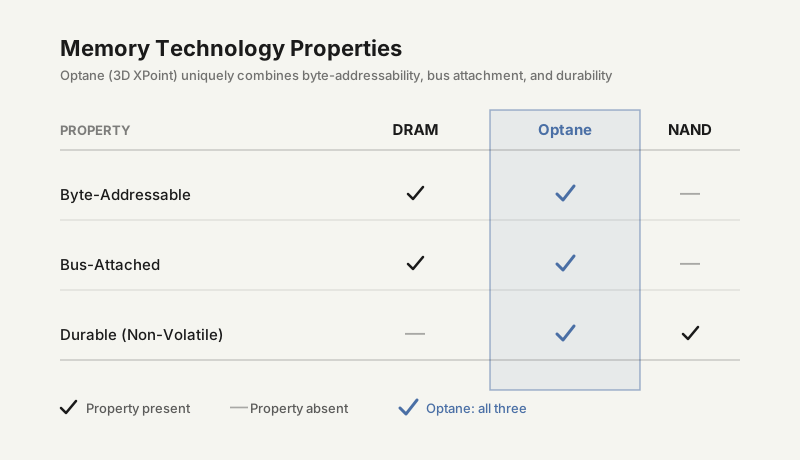
But the business framing buries the architectural one. Optane, built on 3D XPoint media co-developed by Intel and Micron, did something no other shipping product did: it sat on the memory bus in a DIMM form factor, byte-addressable, accessible through ordinary CPU load and store instructions, and it kept its contents through a power cycle. That combination — not any single attribute — is what made it special. NAND is non-volatile but block-addressed and far too slow for the memory bus. DRAM is byte-addressable and fast but volatile. Optane was the only mainstream media that was all three: byte-addressable, bus-attached, and durable.
When it left, the gap it left was not a missing SKU. It was a missing tier. The question is no longer "which chip replaces 3D XPoint" but "where does durability now physically live."
Backward reference: for readers who want the memory-hierarchy fundamentals — why a DRAM-bus storage-class tier mattered in the first place, and how the bandwidth wall pushed architects toward it — see our earlier coverage on HBM and the memory-bandwidth wall.
The Successor Is an Interconnect, Not a Cell
The emerging consensus is that the successor vector is the interconnect. CXL — a cache-coherent link layered over PCIe — is repeatedly positioned as the Optane successor path, or, more bluntly, the sole-survivor path for persistent memory (Hacker News discussion, 2023). The academic-community framing arrived early: the post-Optane world is a CXL-tiered memory model, not a single-chip replacement (SIGARCH, 2022). Recent explainers echo the same tiering narrative (CoreWave Labs, 2025; InnovatX, 2025).
This is true as far as it goes, and it is also where the conversation tends to stop. CXL gives you a memory tier beyond DRAM — capacity that is composable, poolable, and fabric-attached rather than bolted into a single server's DIMM slots. That much was already being prototyped before CXL silicon was broadly available: vendors built software-defined composable memory pools as a pre-CXL bridge (TechTarget, 2022).
But notice what the tiering story does not answer. Composable pooling is about capacity and sharing. It says nothing about non-volatility. A pooled, disaggregated memory tier can be entirely volatile. Putting memory on CXL does not, by itself, make it durable. So if CXL is the successor to a product whose defining trait was durability, the obvious question is: what supplies the durability now?
Forward reference: a dedicated primer on CXL fundamentals — coherence, pooling, and disaggregation — is in our pipeline as the companion to this piece.
Where Durability Now Physically Lives
Here is the seam the existing coverage leaves unexplained. There are two fundamentally different ways to deliver "persistent memory" in a post-Optane system, and they offer different guarantees.
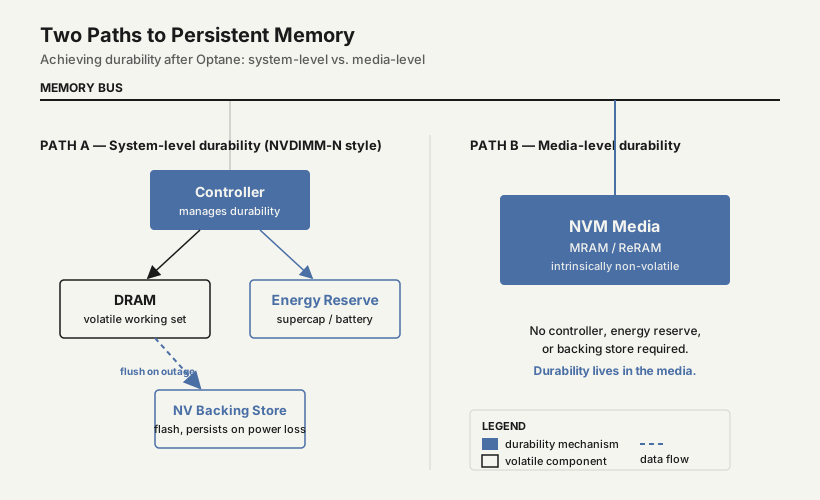
(a) DRAM plus power-loss protection, at the controller layer. A CXL module can present what looks like ordinary memory — DRAM, in fact — while adding a mechanism that, on power loss, flushes in-flight and resident data to a non-volatile backing store using a local energy reserve. The media itself is volatile. Durability is an emergent system property, manufactured by a controller that promises to finish the job when the lights go out. This is consistent with current framing of CXL modules as a tier that presents DRAM-like memory while adding power-loss protection (InnovatX, 2025).
(b) Genuinely non-volatile media on the bus. The alternative is a cell that is intrinsically durable — phase-change memory (the 3D XPoint lineage), or one of the emerging contenders: MRAM/STT-MRAM, ReRAM, FeRAM. Here durability is a media property. The bit survives because the physics of the bit survives. No controller heroics, no energy reserve, no flush window. This is what 3D XPoint delivered, and it is the model whose mainstream representative just left the market.
The distinction matters because the two models fail differently. A media-level guarantee survives anything that does not destroy the cell. A system-level guarantee — DRAM plus flush-on-power-loss — is only as good as the energy reserve, the flush path, and the controller's correctness under exactly the conditions (sudden power loss) when everything else is also going wrong. The industry, in moving from Optane to CXL, has quietly traded a media-level guarantee for a system-level one in many designs. That trade is rarely stated out loud, and practitioners building on these systems should understand which guarantee they are actually buying.
This reframes "persistence migrated from media to interconnect" from a slogan into a concrete engineering claim: durability is increasingly delivered at the controller and interconnect layer rather than by a novel persistent cell.
The Open Seam: How a Write Becomes Durable Across a Fabric
Even granting a durability mechanism, there is a harder question that almost no accessible writing addresses: when is a write actually durable?
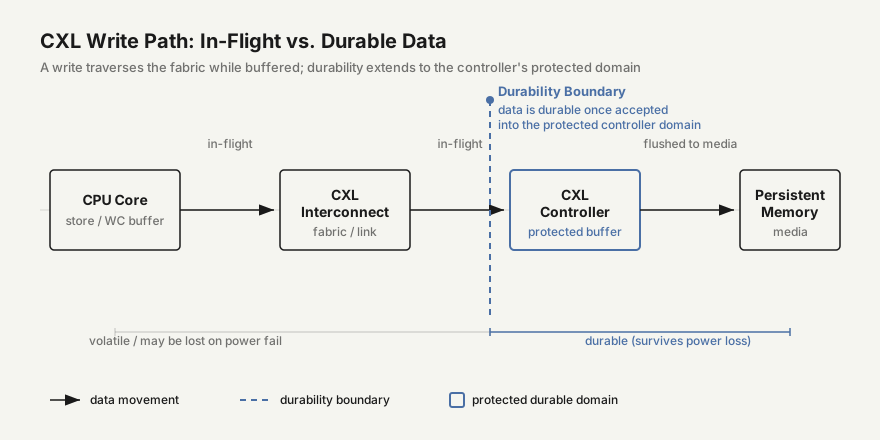
On Optane, the durability boundary was relatively local — a question of getting data out of volatile CPU caches and into the persistent DIMM, with well-known flush and fence semantics. Move persistence onto a fabric-attached, potentially pooled CXL device, and that boundary stretches across a link. A store that has left the core is not necessarily durable; it may be in flight, in a buffer, in the controller, not yet committed to whatever backs it. The system needs a defined point at which it can promise: this write will survive.
The CXL specification defines durability and flush semantics for exactly this purpose, but the precise mechanism — the primitive that forces in-flight data to a power-fail-safe domain, and the specification version that introduces it — is something we will not assert here without a direct citation to the specification text. It is the single most important unexplained detail in the post-Optane persistence story, and we are flagging it as the subject of dedicated follow-up rather than paraphrasing it imprecisely.
Forward reference: we are preparing a deep-dive specifically on CXL fabric persistence and durability semantics — how a write is forced to a power-fail-safe domain across the link, and which specification revision governs it.
The Device-Physics Question
If durability returns to the media — option (b) above — it will be because one of the emerging non-volatile technologies reaches the density, endurance, and latency needed to sit on the bus at DIMM scale. The candidate set is well known by name: phase-change memory, MRAM/STT-MRAM, ReRAM, FeRAM.
We will not rank them here. Their relative 2024 standings on density, endurance, and latency — and critically, whether any has reached DIMM-scale capacity capable of replacing 3D XPoint on the memory bus — is precisely the kind of specific technical claim that demands primary-source verification we have not completed. Stating it from memory would be guessing, and guessing about device physics is how errors propagate. We are holding the comparison for a dedicated treatment grounded in device-level sources.
Forward reference: an emerging-NVM device-physics deep-dive — MRAM vs. ReRAM vs. FeRAM vs. PCM, on density, endurance, and latency — is the natural companion to this article.
Future Speculation
Speculation: persistence becomes a system property, possibly permanently. Grounded in the verified CXL-successor framing and the "next tier beyond DRAM" coverage (InnovatX, 2025), the most likely near-term trajectory is that durability is supplied at the interconnect and controller layer — DRAM-like modules with power-loss protection — rather than by a novel persistent cell. If this holds, the industry's working definition of "persistent memory" shifts from "memory that is intrinsically non-volatile" to "memory a controller promises to make durable." That is a meaningful semantic change, and it places more of the durability burden on system correctness than on materials science.
Speculation: disaggregation and persistence converge. Composable, pooled memory was already shipping before CXL silicon was broadly available (TechTarget, 2022). Extending that trajectory, persistent capacity could become a fabric-attached, shareable resource — durability as a property of a pool rather than of a DIMM in one server. This is a structural complement to memory-disaggregated datacenter design rather than a separate trend.
Speculation (device-level, explicitly unverified): the two models may converge. Whether an emerging non-volatile media — MRAM or ReRAM in particular — eventually pairs with a CXL controller to recreate true byte-addressable non-volatility, rather than DRAM-plus-energy-reserve emulation, is a genuine open question. We flag it as speculation precisely because the underlying device-physics standings remain unverified in this pass. If it happens, the post-Optane era would end not with the interconnect replacing the media, but with the interconnect and a new media arriving together — durability delivered at both layers at once.
The Takeaway
Optane's end is usually told as an obituary or as a coronation: the product died; long live CXL. Both readings miss the mechanism. What actually changed is the location of the guarantee. 3D XPoint made a write durable in the physics of the cell. Much of the post-Optane landscape makes a write durable through a controller's promise to flush on power loss — a system-level guarantee stretched across an interconnect, with a durability boundary that now lives somewhere on the wire rather than in the bit.
For engineers building on these systems, that is the question worth asking of any "persistent memory" product in the CXL era: is the durability in the media, or in the controller — and exactly when does my write cross the line into safe? The honest answer, for now, depends on which of the two models you bought, and on specification details worth reading directly rather than taking on faith.
A note on figures: this article deliberately omits market-size and growth-rate projections. The quantitative estimates available for this topic carry unverified, non-peer-reviewed methodologies, and we do not publish market figures we cannot trace to a citable primary source.
Sources
- The Register, "Why Intel killed its Optane memory business" (2022) — https://www.theregister.com/2022/07/29/intel_optane_memory_dead/
- Intel, "Announcement: EOL for Intel Optane Memory Products" (2022) — https://www.intel.com/content/www/us/en/support/articles/000057951/memory-and-storage/intel-optane-memory.html
- Intel, "Optane Business Update — Warranty and Support" (2022) — https://www.intel.com/content/www/us/en/support/articles/000091826/memory-and-storage.html
- Tom's Hardware, "Intel schedules the end of its 200-series Optane memory DIMMs" (2024) — https://www.tomshardware.com/pc-components/ssds/intel-schedules-the-end-of-its-200-series-optane-memory-dimms-shipments-to-draw-to-an-end-in-late-2025
- Hacker News discussion, "CXL for Persistent Memory, as the Optane successor" (2023) — https://news.ycombinator.com/item?id=37946421
- SIGARCH (ACM), "Persistent Memory — A New Hope" (2022) — https://www.sigarch.org/persistent-memory-a-new-hope/
- TechTarget, "MemVerge, Liqid create composable memory pools before CXL" (2022) — https://www.techtarget.com/searchstorage/news/252515649/MemVerge-Liqid-create-composable-memory-pools-before-CXL
- CoreWave Labs, "Persistent Memory vs RAM — CXL & Post-Optane Guide" (2025) — https://corewavelabs.com/persistent-memory-vs-ram-cxl/
- InnovatX Blog, "Persistent Memory & CXL — The Next Tier Beyond DRAM" (2025) — https://innovatxblog.blogspot.com/2025/06/persistent-memory-cxl-next-tier-beyond-dram.html